
Short answer
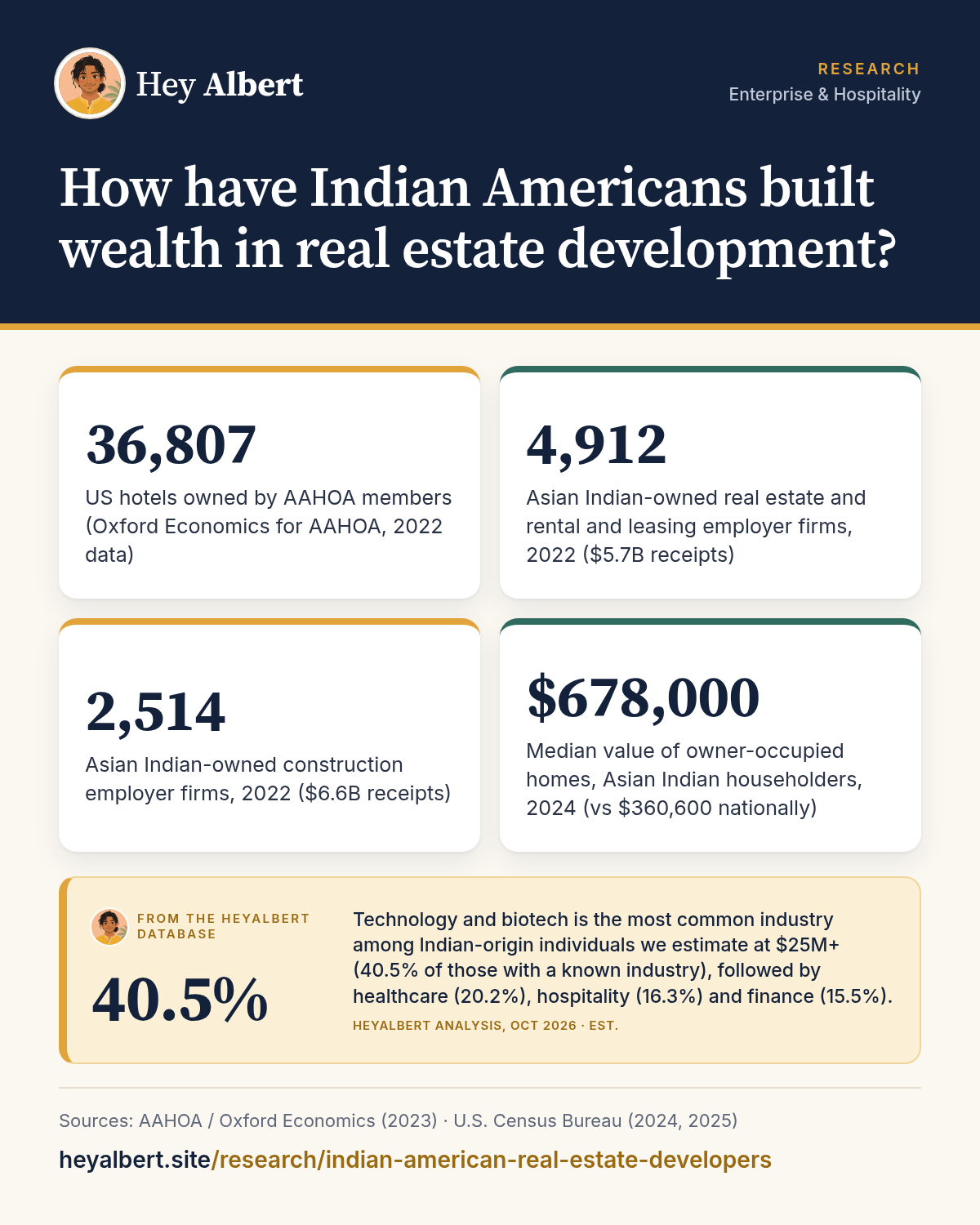
Real estate is the asset where many Indian American family fortunes end up, whether they began in hotels, medicine or technology. AAHOA members, most of them Indian American, own 36,807 US hotels1, Asian Indian-owned real estate and construction firms had $12.2 billion in combined receipts in 2022 (our calculation from Census data)2, and Asian Indian homeowners report a median home value of $678,000, nearly double the national figure3.
HeyAlbert data shows technology and biotech is the most common industry among Indian-origin individuals we estimate at $25M+ (40.5% of those with a known industry), followed by healthcare (20.2%), hospitality (16.3%) and finance (15.5%). See the data · Methodology
Hotels: the original real estate business
For Indian Americans, hotel ownership has always been a real estate business as much as a hospitality one. A motel is land and a building that produce income, can be refinanced to buy the next property and appreciate over time. According to an Oxford Economics study for AAHOA, the hotel owners' association whose members are mostly Indian American, members owned 36,807 hotels with 3.2 million guestrooms in 20221. That makes hotels the largest single category of Indian American commercial property ownership. The story of how families built those portfolios is told in why Patels own so many motels and how many hotels Indian Americans own.
Sociologist Pawan Dhingra notes that second-generation owners who stay in the industry usually enter at a higher tier, moving into branded and upscale properties5. That shift turns operators into developers: families who once bought older roadside motels now build new franchised hotels from the ground up.
What HeyAlbert data shows
From motel to REIT: the Hersha example
The clearest public example of that progression is Hersha Hospitality. NPR reported in 2016 that the company began with a 23-room motel in rural Pennsylvania, where the founding family lived behind the lobby, and had grown into a $2.5 billion hotel company4. The path from a single property to a publicly traded real estate investment trust illustrates how hotel cash flow, family capital and access to public markets can compound across a generation. The economic footprint of the wider industry is covered in the economic impact of Indian American hoteliers.
The same playbook repeats at smaller scale across the country. An owner buys an older property, improves it and secures a national brand flag, then uses the higher value as collateral for the next acquisition or a new build. Over time, some families shift from operating hotels to developing and owning them, hiring management companies to run day-to-day operations. That separation of ownership from operations is what makes a hotel portfolio function like a real estate holding, and it is a common step before families form investment partnerships, bring in outside capital or set up family offices, a topic covered in how wealthy Indian Americans run family offices.
Real estate and construction firms
Beyond hotels, the Census Bureau's Annual Business Survey counted 4,912 Asian Indian-owned employer firms in real estate and rental and leasing in 2022, with $5.7 billion in receipts and 18,377 employees, and 2,514 Asian Indian-owned construction firms with $6.6 billion in receipts and 16,480 employees2.
| Asian Indian-owned employer firms, 2022 | Firms | Receipts | Employees |
|---|---|---|---|
| Real estate and rental and leasing | 4,912 | $5.7B | 18,377 |
| Construction | 2,514 | $6.6B | 16,480 |
Source: US Census Bureau, Annual Business Survey 20222. These counts understate real estate activity. The survey covers only firms with paid employees, and much investment property is held in partnerships and holding companies that have no staff of their own. Hotels are counted separately, under accommodation. The wider business picture is in how many businesses Indian Americans own.
Home values and personal real estate
Real estate also dominates many household balance sheets. In 2024, 63.0% of Asian Indian householders owned their homes, slightly below the national rate of 65.3%, but the median value of those homes was $678,000, compared with $360,600 for all US owner-occupied homes3. Median monthly owner costs with a mortgage were $3,603 against $2,035 nationally3. The gap reflects where Indian Americans live: expensive metro areas such as the Bay Area, New York and New Jersey, and the suburbs of Dallas, Houston and Atlanta. Property often makes up a large share of household net worth for these families, alongside retirement accounts and company stock.
Why real estate appeals to Indian American families
Several features make property attractive to Indian American wealth builders. It is tangible and familiar, it can be financed with leverage, and it can be held and passed down across generations. Professionals with high incomes often buy rental properties, medical office buildings or stakes in syndicated deals as a way to diversify away from salaries and concentrated company stock. Families that built operating businesses, such as hotels or convenience stores, frequently keep the land and buildings even after selling or leasing the business itself.
Concentration in property brings its own planning issues, including liquidity, succession among siblings and holdings in both the US and India. See family businesses and Indian American wealth and intergenerational wealth transfer, and on holdings abroad, property in India.
Frequently asked questions
Do Indian Americans own a lot of real estate?
Yes, especially hotels. AAHOA members, mostly Indian American, own 36,807 US hotels. Census data also show 4,912 Asian Indian-owned real estate firms and 2,514 construction firms with paid employees in 2022.
What are some examples of Indian American real estate companies?
Hersha Hospitality is a well-documented example: NPR reported it grew from a 23-room Pennsylvania motel into a $2.5 billion hotel company.
How valuable are Indian American homes?
In 2024 the median value of homes owned by Asian Indian householders was $678,000, compared with $360,600 for all US owner-occupied homes, according to the American Community Survey.
Why do Census counts understate Indian American real estate holdings?
The business survey counts only firms with paid employees, and many investment properties are held through partnerships and holding companies that have no staff.
Sources
Figures are from the public sources below, with the data year stated. Estimates are labeled as estimates. Accessed October 24, 2026.
- AAHOA / Oxford Economics, AAHOA Members' Economic Contribution to the U.S. Economy (Oxford Economics study page) (2023). aahoa.com ↩ ↩ ↩
- US Census Bureau, Annual Business Survey: Statistics for Employer Firms by Industry, Sex, Ethnicity, Race, and Veteran Status for the U.S.: 2022 (AB2200CSA01) (2024). data.census.gov ↩ ↩ ↩
- US Census Bureau, American Community Survey 2024 1-year, Selected Population Profile (S0201), Asian Indian alone (2025). data.census.gov ↩ ↩ ↩
- NPR, Here To Stay: How Indian-Born Innkeepers Revolutionized America's Motels (2016). npr.org ↩ ↩
- NPR, 'Life Behind The Lobby' Of Indian-American Motels (interview with Pawan Dhingra) (2012). npr.org ↩