
Short answer
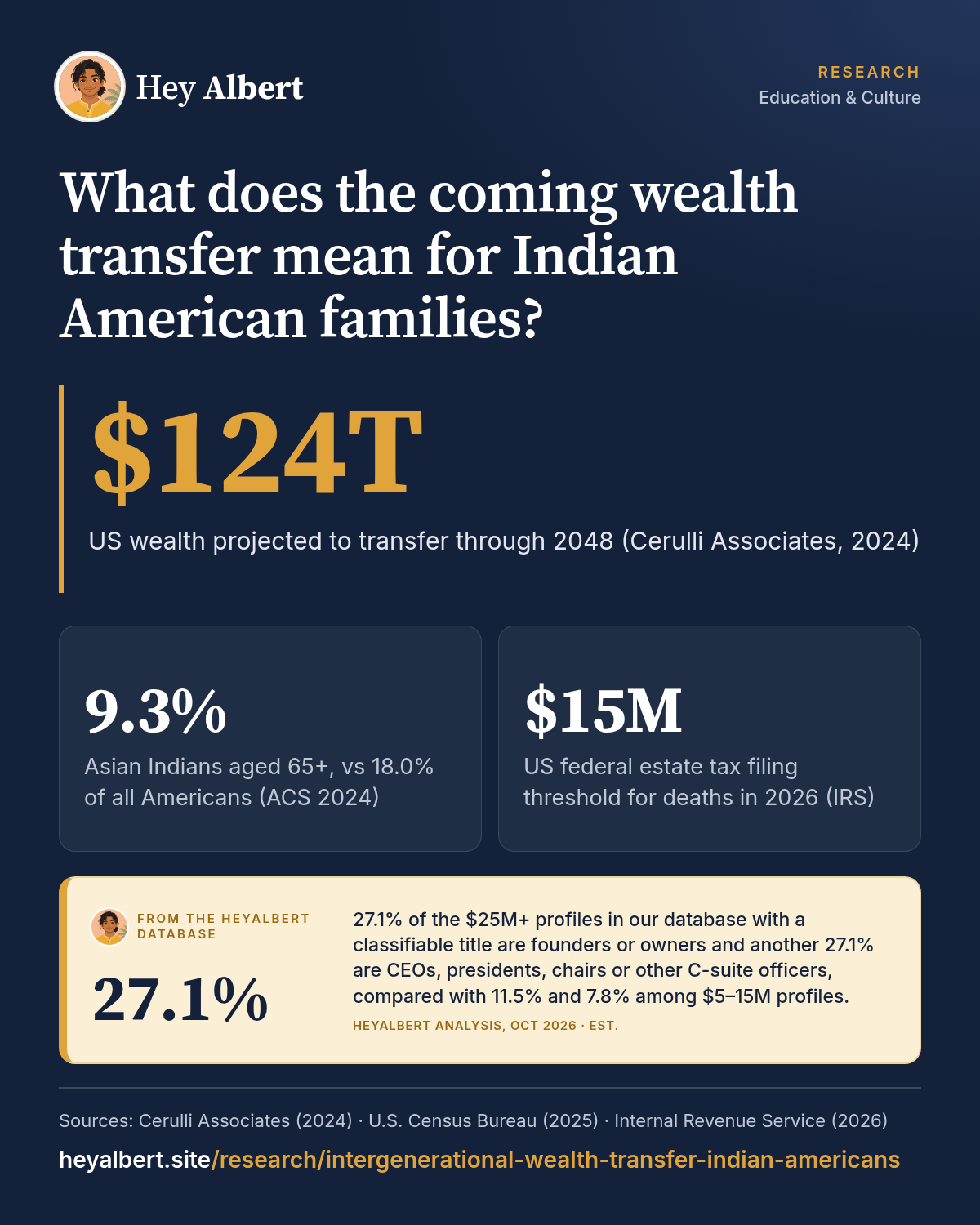
Nationally, Cerulli Associates projects $124 trillion in US wealth will be transferred through 2048, mostly from Baby Boomers1. Indian American families are earlier in that cycle: only 9.3% of Asian Indians were 65 or older in 2024, versus 18.0% of all Americans, and 72% of Asian Indian immigrants arrived in 2000 or later2,3. Their large transfers are mostly still ahead, and many will involve assets and heirs in both the US and India.
HeyAlbert data shows 27.1% of the $25M+ profiles in our database with a classifiable title are founders or owners and another 27.1% are CEOs, presidents, chairs or other C-suite officers, compared with 11.5% and 7.8% among $5–15M profiles. See the data · Methodology
The national picture
Cerulli Associates projects that $124 trillion in wealth will be transferred in the US through 2048, with $105 trillion expected to go to heirs and $18 trillion to charity1. Nearly $100 trillion, or 81%, will come from Baby Boomers and older generations, and more than half of the total ($62 trillion) from households that are currently high-net-worth or ultra-high-net-worth, which make up only 2% of households1. Cerulli also expects $54 trillion to pass first to spouses before moving to the next generation1. By generation, Millennials are expected to inherit the most over the next 25 years ($46 trillion), while Gen X stands to inherit the larger amount in the next 10 years ($14 trillion, against $8 trillion for Millennials)1.
What HeyAlbert data shows
Indian American families are earlier in the cycle
The Indian American community's age profile is very different from the country's. In 2024, the median age of Asian Indians was 36.1 and only 9.3% were 65 or older, compared with a national median of 39.2 and 18.0% aged 65 and over2,3. Among Asian Indian immigrants, 50.2% arrived in 2010 or later and another 22.0% between 2000 and 20092. Most of the wealth they hold was built in the last two or three decades and is still owned by people in their working years.
That means the community's largest intergenerational transfers are mostly ahead. Pew counted 1.65 million US-born Indian Americans in 2023, most of them still children7. As immigrant parents retire over the coming decades, wealth will begin to move to this generation, a shift we discuss in second-generation Indian American income and the future of Indian American wealth.
How much wealth is involved?
No survey measures Indian American wealth directly at the national level; see Indian American household net worth for why. The broader Asian American benchmark is substantial: the Census Bureau found 27.5% of non-Hispanic Asian households had $1 million or more in wealth at the end of 20238. With Asian Indian households earning a median of $165,721 in 2024, about twice the national median2,3, and a large share owning homes worth a median of $678,0002, many families will have meaningful estates to pass on. At the top end, founders and executives hold concentrated stakes in companies, which raises distinct succession questions covered in Indian American family businesses.
Cross-border complications
Many Indian American families have parents, siblings, property or heirs in India, and the two tax systems treat transfers very differently:
- United States: an estate tax return is required when the gross estate, plus certain lifetime gifts, exceeds $15 million for deaths in 2026, and a surviving spouse can elect to use a deceased spouse's unused exemption4.
- Nonresident non-citizens: for people who are neither US citizens nor US residents, such as parents living in India who own US assets, the filing threshold is just $60,000 of US-situated property5.
- India: there is no inheritance tax and no wealth tax, and donors owe no gift tax; gifts over INR 50,000 a year from non-relatives can be taxable income to the recipient, with exemptions for relatives6.
These rules are summaries, not advice, and treaties, residency and asset location all matter. We go into the details in cross-border estate planning for Indian Americans and FBAR, FATCA and the US–India tax treaty.
Spouses, giving and family structure
Two features of Indian American households shape how transfers will unfold. First, marriage rates are high: 66.0% of Asian Indians aged 15 and over were married in 2024, versus 47.9% nationally2,3, so a large share of wealth will pass first to a surviving spouse, the pattern Cerulli highlights nationally1. Second, many households already span generations under one roof, which means support often flows between parents and adult children long before any formal inheritance; see multigenerational living in Indian American households. Charitable giving is a third channel, as Cerulli's $18 trillion charity estimate suggests nationally1.
What families and advisors are watching
For Indian American families, the practical questions tend to be: how to hold assets across two countries, how to treat heirs who live in different places, how to pass on stakes in family businesses or startups, and how to build philanthropy into the plan. With most of the community's transfers still a decade or more away, families who plan early have the widest range of options.
Frequently asked questions
How much wealth will be transferred in the US in the coming decades?
Cerulli Associates projects 124 trillion dollars through 2048, with 105 trillion going to heirs and 18 trillion to charity.
Does India have an inheritance tax?
No. India has no inheritance tax and no wealth tax. Gifts above a small threshold from non-relatives can be taxed as income to the recipient.
What is the US estate tax threshold in 2026?
The IRS filing threshold is 15 million dollars for deaths in 2026. For nonresidents who are not US citizens, the threshold is 60,000 dollars of US-situated assets.
When will Indian American families see large wealth transfers?
Mostly in the coming decades. The community is younger than average, with only about 9 percent aged 65 or older in 2024, so most wealth is still held by people in their working years.
Sources
Figures are from the public sources below, with the data year stated. Estimates are labeled as estimates. Accessed October 24, 2026.
- Cerulli Associates, Cerulli Anticipates $124 Trillion in Wealth Will Transfer Through 2048 (2024). cerulli.com ↩ ↩ ↩
- U.S. Census Bureau, Selected Population Profile in the United States (S0201): Asian Indian alone, 2024 ACS 1-year estimates (2025). data.census.gov ↩ ↩ ↩
- U.S. Census Bureau, Selected Population Profile in the United States (S0201): Total population, 2024 ACS 1-year estimates (2025). data.census.gov ↩ ↩ ↩
- Internal Revenue Service, Estate tax (2026). irs.gov ↩ ↩
- Internal Revenue Service, Estate tax for nonresidents not citizens of the United States (2026). irs.gov ↩ ↩
- PwC Worldwide Tax Summaries, India: Individual — Other taxes (2026). taxsummaries.pwc.com ↩ ↩
- Pew Research Center, Facts about Indians in the U.S. (2025). pewresearch.org ↩
- U.S. Census Bureau, Wealth of Households: 2023 (P70BR-211) (2025). www2.census.gov ↩