
Short answer
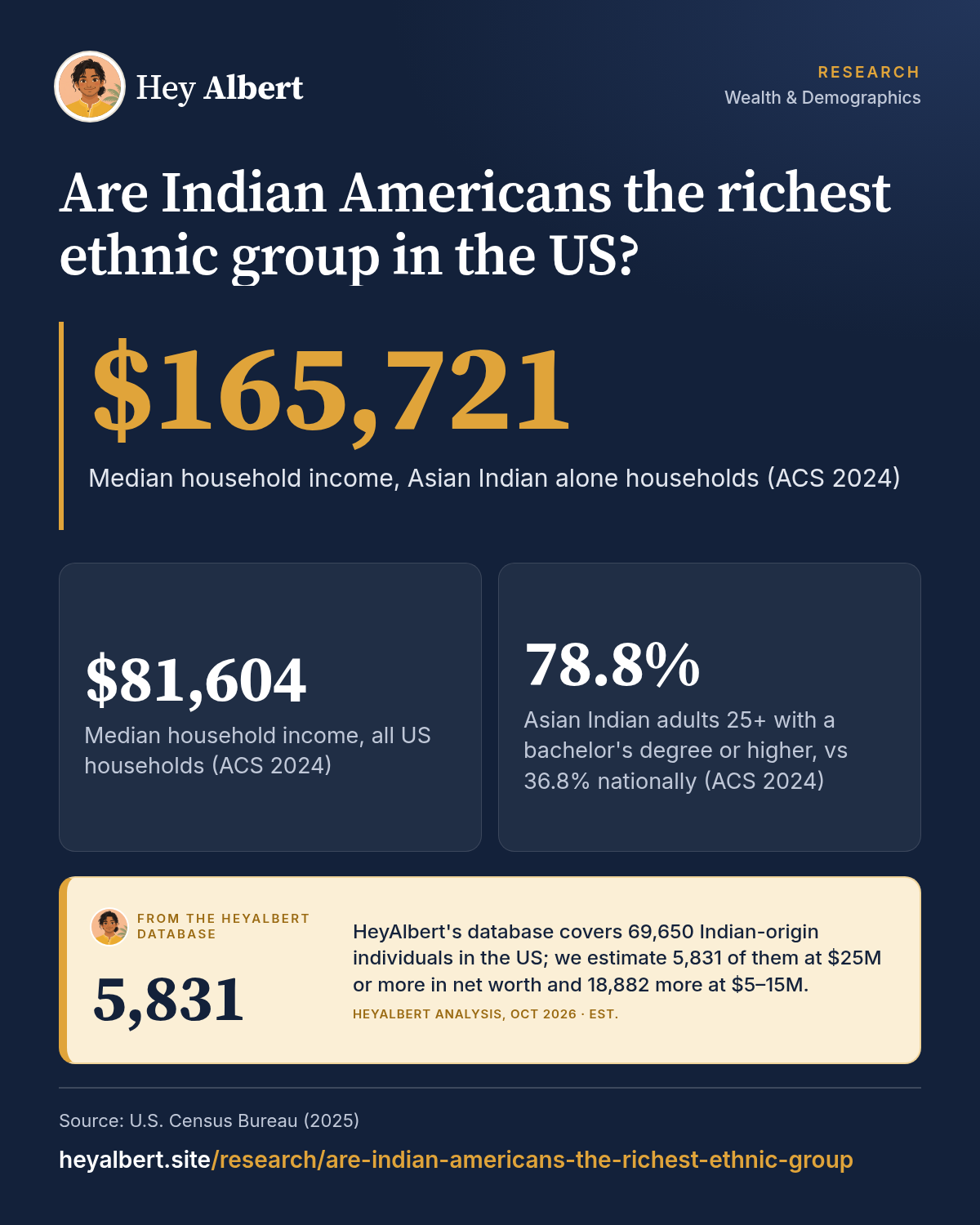
By household income, yes. In 2024, households headed by someone who identifies as Asian Indian alone had a median income of $165,721, the highest of any racial, ethnic or ancestry group in the Census Bureau's national profiles and about twice the US median of $81,6041,2. Group-specific wealth (net worth) data is far thinner, but the available surveys also place Indian American households near the top4,5.
HeyAlbert data shows HeyAlbert's database covers 69,650 Indian-origin individuals in the US; we estimate 5,831 of them at $25M or more in net worth and 18,882 more at $5–15M. See the data · Methodology
The short answer: highest by income
The best public measure for comparing groups is the Census Bureau's American Community Survey (ACS). In the 2024 one-year data, the most recent available as of October 2026, households with an Asian Indian householder had a median income of $165,7211. The figure for all US households was $81,6042, so the typical Indian American household earned roughly twice as much as the typical American household.
That is the top figure among the roughly 500 race, Hispanic-origin, ancestry and birthplace groups the Census Bureau profiles nationally in its Selected Population Profiles. The only higher line in that table is a subset of the same community: households headed by someone born in India1. Pew Research Center, working from a different cut of the ACS (2021–23, alone or in combination), reached the same conclusion with a median of $151,200 in 20233. For a year-by-year view of the income numbers, see our breakdown of Indian American median household income.
What HeyAlbert data shows
How Indian Americans compare with other groups
Median household income by group, ACS 2024 one-year estimates1,2:
| Group (householder) | Median household income |
|---|---|
| Asian Indian alone | $165,721 |
| Taiwanese alone | $144,743 |
| Filipino alone | $117,783 |
| Asian alone (all origins) | $117,289 |
| Pakistani alone | $111,719 |
| Chinese alone | $111,125 |
| White alone, not Hispanic | $87,572 |
| All US households | $81,604 |
| Hispanic or Latino (any race) | $72,574 |
| Black alone | $56,706 |
The ranking depends a little on the measure. Per capita income adjusts for household size, and on that basis Taiwanese Americans ($83,810) edge out Asian Indians ($76,212), partly because Indian American households are larger on average (2.85 people versus 2.39)1. We look at these trade-offs in more detail in how Indian American income and wealth compare with other groups.
What about wealth and net worth?
Income is not wealth. Net worth, meaning assets minus debts, builds over decades and depends on inheritance, home equity and investment returns as well as pay. Here the data is much thinner, because the main national wealth surveys do not publish results for Indian Americans as a separate group.
What exists points the same way. The Urban Institute's analysis of the Federal Reserve's 2022 Survey of Consumer Finances found that Asian American households had a median net worth of $535,400, close to double that of white households4. The Census Bureau's own wealth survey found that 27.5% of non-Hispanic Asian households held $1 million or more in wealth at the end of 2023, compared with 22.2% of non-Hispanic white households6. One of the few studies to measure Indian Americans directly, a 2016 report on the Los Angeles area, estimated median Asian Indian household wealth at $460,000, against $355,000 for white households5. Our guide to Indian American household net worth sets out what these surveys can and cannot tell you.
Why the gap exists
The evidence points mostly to who immigrated, not to anything innate. About 69% of Asian Indians in the US were born abroad1, and US immigration rules have favored highly educated applicants. Indian nationals received 71% of all H-1B visas for skilled workers in fiscal 20247. That selection shows up in education: 78.8% of Asian Indian adults aged 25 and over hold at least a bachelor's degree and 46.4% hold a graduate or professional degree, compared with 36.8% and 14.7% of all US adults1. It also shows up in jobs: 75.7% of employed Asian Indians work in management, business, science and arts occupations, versus 43.5% of all workers1.
Household structure adds to the picture. Asian Indian households are more likely to be married couples (69.7% versus 46.7% nationally), so more households have two earners1. We look at each driver in why Indian Americans are wealthier than the average American, and at the role of degrees in Indian American education levels.
What the averages hide
A high median does not mean everyone is affluent. The Asian Indian poverty rate was 6.7% in 2024, lower than the national 12.1% but still hundreds of thousands of people1. Half of Asian Indian immigrants arrived in 2010 or later1, and newer arrivals, students and people on temporary visas often earn far less than long-settled professionals. Pew's work on income inequality found that Indian Americans rank highest among Asian origin groups at both the bottom tenth and the top tenth of the income ladder, but that the gap between those two points has widened since 19808. For the full spread, see how income is distributed among Indian Americans.
Bottom line
On the measure most people mean, median household income, Indian Americans are the highest-earning ethnic group in the United States, and by a wide margin. On wealth, the best available evidence puts them near the top too, though no official survey yet publishes a precise national figure for the group. For the people at the very top of the distribution, see our research on Indian American millionaires and billionaires.
Frequently asked questions
What is the richest ethnic group in America?
By median household income, Indian Americans are the highest-earning group in Census Bureau data, at $165,721 in 2024 compared with $81,604 for all US households.
Are Indian Americans richer than white Americans?
By income, yes: the median for Asian Indian households was $165,721 in 2024, versus $87,572 for non-Hispanic white households. No official national survey publishes Indian-only wealth figures, but available studies also show higher median net worth.
Is per capita income also highest for Indian Americans?
Not quite. Indian American households are larger than average, and on a per capita basis Taiwanese Americans were slightly higher in 2024, at $83,810 versus $76,212.
Are all Indian Americans wealthy?
No. About 6.7% of Asian Indians lived in poverty in 2024, and incomes vary widely by length of time in the US, visa status, occupation and region.
Sources
Figures are from the public sources below, with the data year stated. Estimates are labeled as estimates. Accessed October 24, 2026.
- U.S. Census Bureau, Selected Population Profile in the United States (S0201): Asian Indian alone and comparison groups, 2024 ACS 1-year estimates (2025). data.census.gov ↩ ↩ ↩
- U.S. Census Bureau, Selected Population Profile in the United States (S0201): Total population, 2024 ACS 1-year estimates (2025). data.census.gov ↩ ↩ ↩
- Pew Research Center, Facts about Indians in the U.S. (2025). pewresearch.org ↩
- Urban Institute, A Snapshot of Asian Wealth in America (2025). apps.urban.org ↩ ↩ ↩
- UCLA Asian American Studies Center, The Color of Wealth in Los Angeles (press release) (2016). aasc.ucla.edu ↩ ↩
- U.S. Census Bureau, Wealth of Households: 2023 (P70BR-211) (2025). www2.census.gov ↩
- Migration Policy Institute, Indian Immigrants in the United States (2026). migrationpolicy.org ↩
- Pew Research Center, Income inequality is greater among Chinese Americans than any other Asian origin group in the U.S. (2024). pewresearch.org ↩