
Short answer
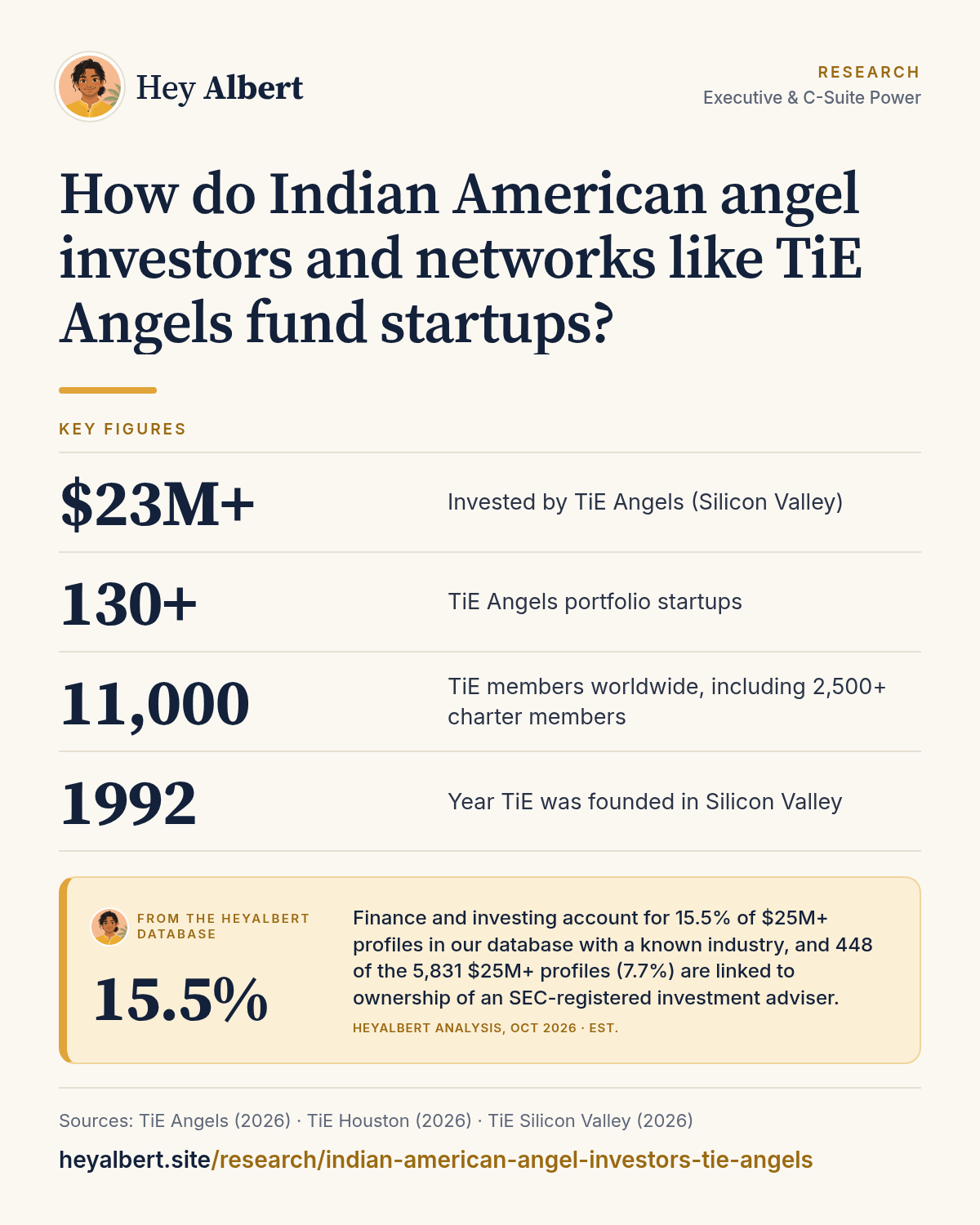
Much Indian American angel investing runs through networks, most prominently TiE. Its Silicon Valley angel group, TiE Angels, has more than 120 active investors and has invested more than $23 million in more than 130 startups1. TiE itself, founded in Silicon Valley in 1992, has about 11,000 members in 60 chapters across 17 countries3,4. Successful founders and executives reinvest their exit wealth into the next generation of companies7,8.
HeyAlbert data shows finance and investing account for 15.5% of $25M+ profiles in our database with a known industry, and 448 of the 5,831 $25M+ profiles (7.7%) are linked to ownership of an SEC-registered investment adviser. See the data · Methodology
TiE: the network behind the network
TiE, short for "The Indus Entrepreneurs", was founded in Silicon Valley in 1992 by entrepreneurs, corporate executives and senior professionals with roots in South Asia3. It describes itself as having about 11,000 members, including more than 2,500 charter members, in 60 chapters across 17 countries4. Its mission is to support entrepreneurship through mentoring, networking and education. Its flagship TiEcon conference and TiE50 awards put early-stage startups in front of investors.
TiE says that since the TiE50 program began, about 85% of winners and top startups have gone on to raise funding, more than a billion dollars in total. At least 29 of their exits were worth more than $100 million each. Examples include FireEye and MuleSoft, which went public, and VeloCloud, which VMware acquired5. Our research on TiE, AAPI and other professional networks covers the wider network.
What HeyAlbert data shows
How TiE Angels works
TiE Angels launched in July 2010 as part of TiE Silicon Valley2. It brings early-stage companies in front of serial entrepreneurs, technology executives and professional investors. Within three years it was recognized as one of the top 20 angel groups in the US1. Today it reports more than 120 active investors, more than $23 million invested and more than 130 portfolio startups1. TiE's global platform also lets charter members in other chapters invest.
The model is typical of organized angel groups. Members screen pitches together, run shared due diligence, and each decides whether to invest personally, often alongside others in a syndicate. That lets individual investors write smaller checks across more companies and draw on the experience of operators who have built and sold companies.
Who can invest
Most private startup rounds are open only to accredited investors. Under SEC rules, an individual generally qualifies with a net worth over $1 million, excluding the primary residence. An individual also qualifies with income over $200,000 ($300,000 with a spouse or partner) in each of the prior two years and the expectation of the same in the current year. Certain licensed investment professionals qualify as well6. High incomes in technology, medicine and finance put many Indian American professionals above these thresholds. The Migration Policy Institute puts the 2024 median income of households headed by an Indian immigrant at $176,20010. Our analysis of how many Indian American millionaires there are covers the wealth side.
What a network-led angel round looks like
From a founder's side, raising money through an angel network usually happens in stages:
- Application and screening. A small committee reviews submissions and invites a short list to pitch.
- Pitch meeting. Founders present to members. Interested investors form a diligence team.
- Diligence. Members with relevant operating experience review the product, market, team and terms, and share their findings with the group.
- Individual decisions. Each member decides whether to invest. Commitments are often pooled so the company sees a single line on its cap table.
- Ongoing support. Investors with domain experience often stay involved as mentors or advisers. TiE emphasizes this part, linking portfolio companies to its global chapter network2.
Founders who became investors
The most influential Indian American angels are usually founders or executives with an exit behind them. Kavitark Ram Shriram was president of Junglee when Amazon bought it in 1998, served as an Amazon vice president, and became one of Google's first backers. He has invested in startups through his firm Sherpalo Ventures since 20007. Vinod Khosla cofounded Sun Microsystems, spent 18 years at Kleiner Perkins and founded Khosla Ventures. According to Forbes, his firm was the first venture investor in OpenAI8. Jay Chaudhry founded and sold four companies before Zscaler9. The founder-to-investor cycle is a big part of why early-stage capital in the community grows over time.
See our profiles of Indian American venture capitalists and the largest exits by Indian American founders.
Why it matters for wealth
Angel investing is high-risk and illiquid. Most early-stage companies fail, and the gains come from a small number of outliers. For wealthy Indian American households, angel and venture investments are usually a small slice of a portfolio that also holds public equities, real estate and cash. Some families build that slice into a structured program through a family office. Our research on how Indian Americans invest and on family offices covers those choices. The startups founded by Indian immigrants are often the companies these networks back.
Frequently asked questions
What is TiE Angels?
An angel investing group within TiE Silicon Valley, launched in 2010. It reports more than 120 active investors, more than $23 million invested and more than 130 portfolio startups.
What does TiE stand for?
The Indus Entrepreneurs. It was founded in Silicon Valley in 1992 and now has about 11,000 members in 60 chapters across 17 countries.
Who can join an angel network?
Most angel groups require members to be accredited investors. Under SEC rules that generally means a net worth over $1 million excluding the primary residence, or income over $200,000 ($300,000 jointly) in each of the last two years.
Who are notable Indian American angel investors?
Prominent examples include Kavitark Ram Shriram, an early Google backer, and Vinod Khosla, whose firm Khosla Ventures was the first venture investor in OpenAI, according to Forbes.
Sources
Figures are from the public sources below, with the data year stated. Estimates are labeled as estimates. Accessed October 24, 2026.
- TiE Angels, TiE Angels (home page) (2026). tieangels.com ↩ ↩ ↩
- TiE Silicon Valley, TiE Angels program (2026). tiesv.ai ↩ ↩
- TiE Silicon Valley, History (2026). tiesv.ai ↩ ↩ ↩
- TiE Houston, About TiE (2026). houston.tie.org ↩ ↩ ↩
- TiEcon / TiE Silicon Valley, TiE50 (2026). tiecon.org ↩
- US Securities and Exchange Commission, Accredited investors (2026). sec.gov ↩
- Forbes, Kavitark Ram Shriram profile (real-time net worth) (2026). forbes.com ↩ ↩
- Forbes, Vinod Khosla profile (2026). forbes.com ↩ ↩
- Forbes, Jay Chaudhry profile (real-time net worth) (2026). forbes.com ↩
- Migration Policy Institute, Indian Immigrants in the United States (2026). migrationpolicy.org ↩