
Short answer
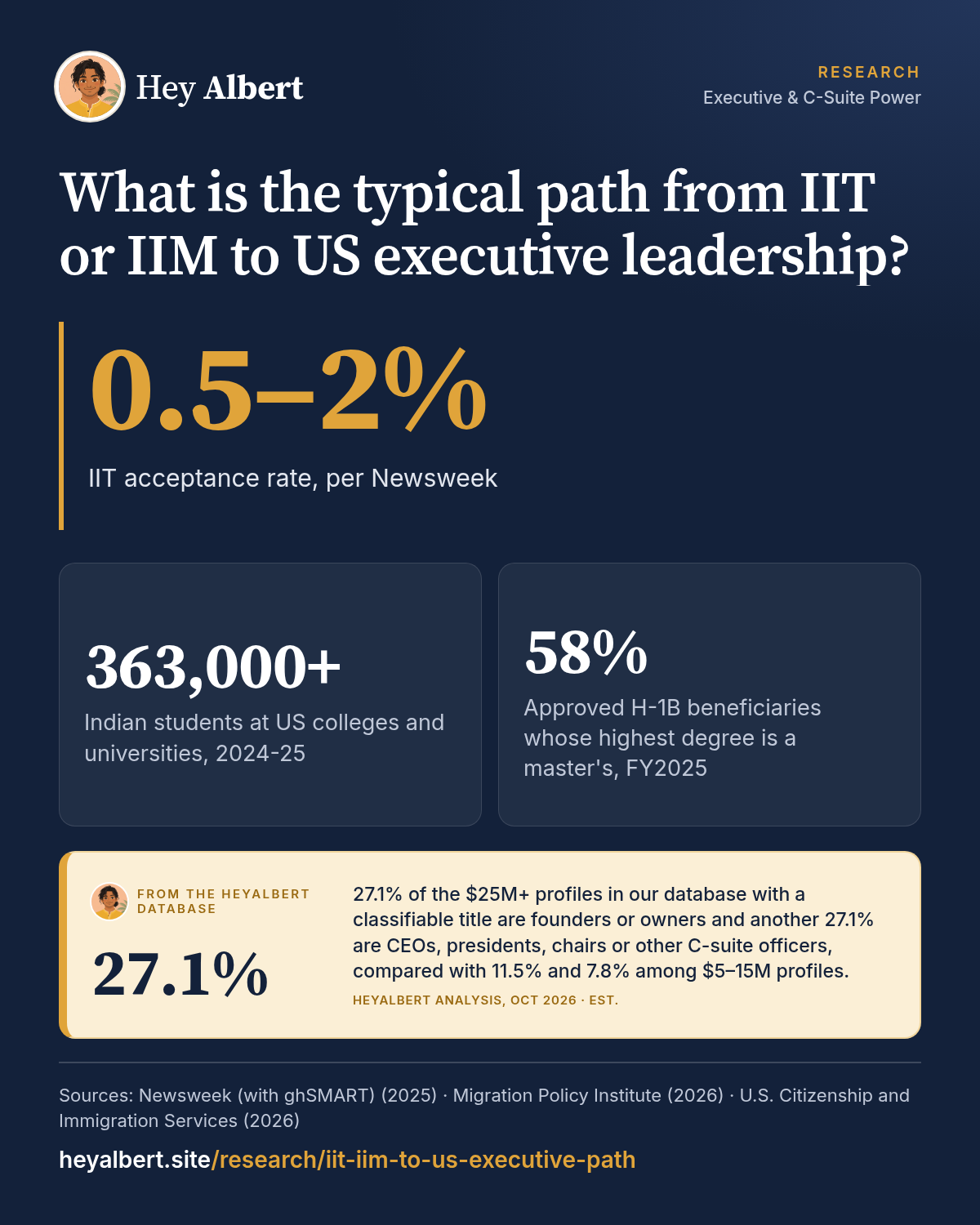
The most common route is an undergraduate engineering degree in India, often from an IIT, followed by a US master's degree or MBA and a long career inside American companies1. Admission to the IITs is extremely selective, at roughly 0.5% to 2% of applicants1. 58% of approved H-1B workers in fiscal 2025 held a master's degree as their highest qualification3.
HeyAlbert data shows 27.1% of the $25M+ profiles in our database with a classifiable title are founders or owners and another 27.1% are CEOs, presidents, chairs or other C-suite officers, compared with 11.5% and 7.8% among $5–15M profiles. See the data · Methodology
Step 1: an elite technical undergraduate degree
India's Institutes of Technology were among the elite institutions set up after independence in 1947. Newsweek reports acceptance rates of roughly 0.5% to 2%, more selective than the Ivy League1. IIT graduates are heavily represented among Indian American business leaders. Forbes records IIT degrees for Romesh Wadhwani (IIT Bombay)4, Vinod Khosla5, Bharat Desai (IIT Bombay)6, Rakesh Gangwal7 and Jay Chaudhry (IIT BHU)8. Sundar Pichai studied metallurgical engineering at IIT Kharagpur1. Newsweek notes that from the 1960s India was producing thousands of English-speaking engineers every year. That gave graduates a ready path into American graduate schools and companies at a time when US industry needed technical talent1.
An IIT degree is common on this path, but it is not required. Satya Nadella did not clear the IIT entrance exam and studied at the Manipal Institute of Technology1. Neha Narkhede studied engineering at the University of Pune11. The common factor is a rigorous technical degree, more than a particular institution. Our article on why so many big tech CEOs are of Indian origin looks at the wider system.
What HeyAlbert data shows
Step 2: a US graduate degree
The second step is almost always a US master's degree, PhD or MBA. It gives the student US credentials, a professional network and, often, a route to a work visa. Wadhwani earned a master's and a PhD at Carnegie Mellon4. Khosla took a master's at Carnegie Mellon and an MBA at Stanford5. Desai earned an MBA at Michigan's Ross School6, Gangwal an MBA at Wharton7, and Nadella a master's at the University of Wisconsin9. Indra Nooyi came to the US for an MBA at the Yale School of Management10.
That pipeline is still running. More than 363,000 Indian students were enrolled at US colleges and universities in 2024-25, more than from any other country, most of them in STEM programs2. Among H-1B workers approved in fiscal 2025, 58% held a master's degree as their highest degree3. See our research on H-1B visas and wealth and Indian American education levels.
Step 3: the long climb inside one company
Many of the best-known executives then spent decades at a single employer. Newsweek's profile of Raj Gupta is the archetype. He graduated from IIT Bombay, arrived at Cornell in 1969 with $8, and joined the chemicals firm Rohm and Haas in 1971. Over four decades there he held 13 jobs on three continents and served 17 bosses. He became chairman and CEO in 1999 and led the company until Dow bought it for $15 billion in 20091. Nadella joined Microsoft in 1992 and became CEO in 2014. Pichai joined Google in 2004 and rose through product management1.
Newsweek's reporting, drawing on ghSMART's research, adds a soft-skill element. Gupta credited his rise partly to learning to speak more directly after early feedback that he lacked conviction1.
The alternative: technical career to founder
A second branch leads from the same education to entrepreneurship. Khosla cofounded Sun Microsystems in 1982 and later spent 18 years at Kleiner Perkins before founding Khosla Ventures5. Wadhwani founded Aspect Development and later SymphonyAI4. Chaudhry founded four security companies before Zscaler8. Desai cofounded Syntel in 1980, after meeting Neerja Sethi while both worked for Tata Consultancy Services6. Our analyses of the largest exits by Indian American founders and of unicorn founders follow this branch.
Where IIM fits
The Indian Institutes of Management are India's leading business schools, and many of their graduates build careers in consulting, banking and multinational companies. Among the US executives profiled here, though, the more common management credential is a US MBA earned after an Indian engineering degree. The IIM route is more visible in consulting and finance than in Silicon Valley. Our research on Indian Americans in management consulting and on professional and alumni networks covers it.
How representative is this path?
The executives named here are exceptional cases, not the typical outcome. The broader pattern still holds for the community: 50% of Indian immigrants aged 25 and over held a graduate or professional degree in 20242, and 77% of Indian Americans aged 25 and over have at least a bachelor's degree12. For most professionals the path leads to senior technical and management roles well below the CEO level, roles that still carry substantial equity compensation.
Frequently asked questions
Do you need an IIT degree to become a US tech CEO?
No. Many prominent leaders are IIT graduates, including Sundar Pichai, but Satya Nadella studied at the Manipal Institute of Technology. A rigorous technical degree plus US graduate study is the more consistent pattern.
Which Indian American billionaires went to IIT?
Forbes lists IIT degrees for Romesh Wadhwani, Vinod Khosla, Bharat Desai, Rakesh Gangwal and Jay Chaudhry, among others.
What US degrees do these executives typically earn?
Usually a master's in engineering or computer science, a PhD, or an MBA. Examples include Carnegie Mellon, Stanford, Wharton, Michigan Ross, Wisconsin and Yale.
Is the IIT-to-US pipeline still active?
Yes. More than 363,000 Indian students were enrolled at US institutions in 2024-25, the most from any country, though new visa fees and restrictions may slow future flows.
Sources
Figures are from the public sources below, with the data year stated. Estimates are labeled as estimates. Accessed October 24, 2026.
- Newsweek (with ghSMART), Indian CEOs in America Are More Common Than Ever—What Sets Them Apart? (2025). newsweek.com ↩ ↩ ↩
- Migration Policy Institute, Indian Immigrants in the United States (2026). migrationpolicy.org ↩ ↩ ↩
- US Citizenship and Immigration Services, Characteristics of H-1B Specialty Occupation Workers, Fiscal Year 2025 Annual Report to Congress (2026). uscis.gov ↩ ↩ ↩
- Forbes, Romesh T. Wadhwani profile (real-time net worth) (2026). forbes.com ↩ ↩ ↩
- Forbes, Vinod Khosla profile (2026). forbes.com ↩ ↩ ↩
- Forbes, Bharat Desai profile (real-time net worth) (2026). forbes.com ↩ ↩ ↩
- Forbes, Rakesh Gangwal profile (real-time net worth) (2026). forbes.com ↩ ↩
- Forbes, Jay Chaudhry profile (real-time net worth) (2026). forbes.com ↩ ↩
- Forbes, Satya Nadella profile (real-time net worth) (2026). forbes.com ↩
- Forbes, Indra Nooyi profile (2024). forbes.com ↩
- Forbes, Neha Narkhede profile (2025). forbes.com ↩
- Pew Research Center, Facts about Indians in the U.S. (2025). pewresearch.org ↩