
Short answer
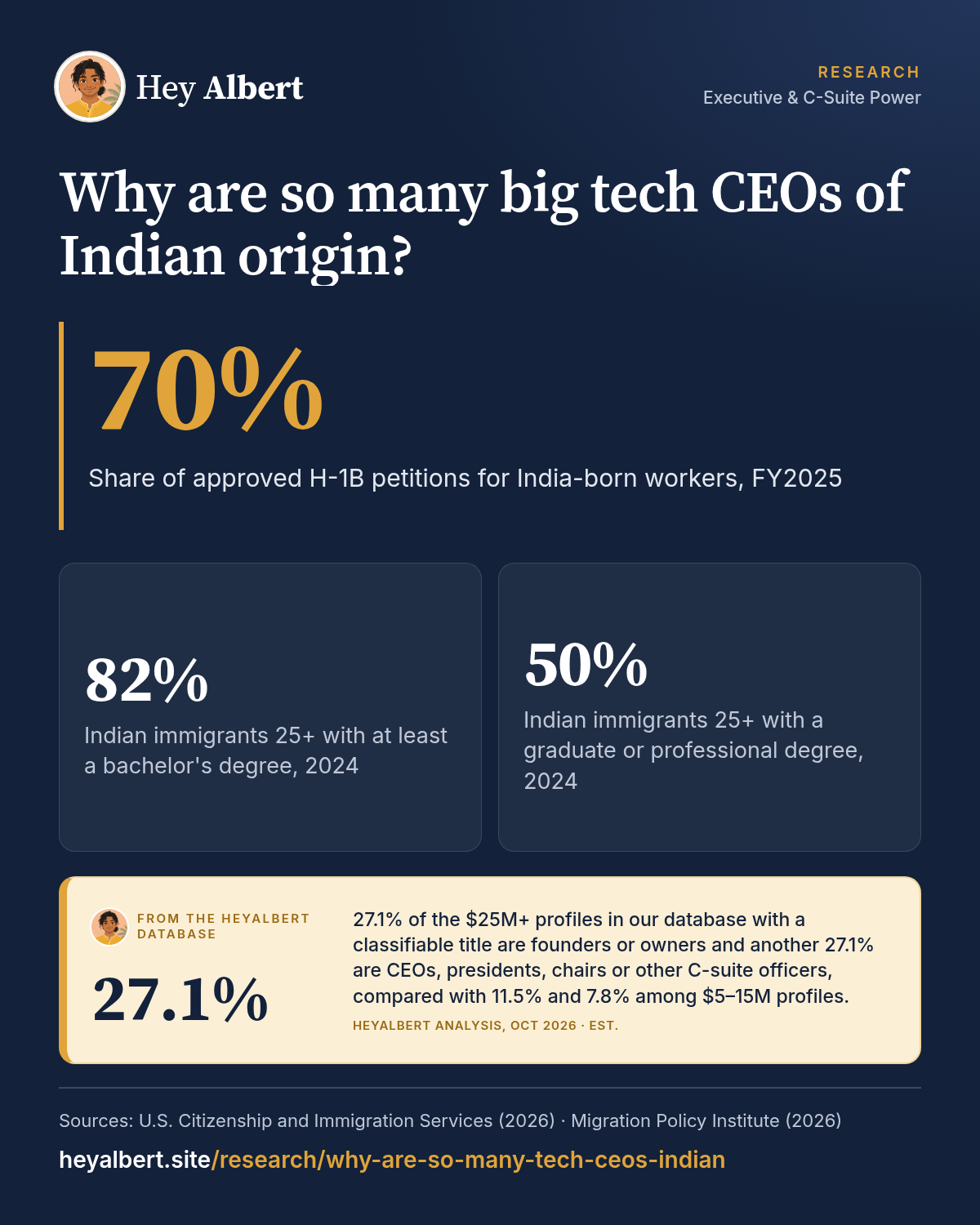
The pattern reflects who came, when they came and what they studied. In 2024, 82% of Indian immigrants held a bachelor's degree and 50% an advanced degree2. In fiscal 2025, 70% of approved H-1B petitions went to people born in India, 62% of them in computer-related jobs3. Many of today's CEOs arrived as engineering graduate students in the 1980s and 1990s and rose inside the companies they now run1.
HeyAlbert data shows 27.1% of the $25M+ profiles in our database with a classifiable title are founders or owners and another 27.1% are CEOs, presidents, chairs or other C-suite officers, compared with 11.5% and 7.8% among $5–15M profiles. See the data · Methodology
Selective, skills-based immigration
The single biggest factor is how Indian immigrants enter the United States. Most arrive on student or employment-based visas tied to advanced education. The Migration Policy Institute reports that 82% of Indian immigrants aged 25 and over held at least a bachelor's degree in 2024, compared with 37% of US-born adults. 50% held a graduate or professional degree2.
The H-1B program is the main entry point for technology talent. In fiscal 2025, 70% of approved H-1B petitions were for people born in India. Computer-related occupations made up 62% of all approvals, and 58% of beneficiaries held a master's degree3. The group arriving through this route is far more technically trained than the population of either country. Our analysis of H-1B visas and Indian American wealth covers the program's economic effects. Indian American education levels are covered separately.
What HeyAlbert data shows
An engineering pipeline built in India
India built elite technical institutes after independence. Newsweek reports that the Indian Institutes of Technology admit roughly 0.5% to 2% of applicants, which makes them more selective than Ivy League schools1. Those schools, along with competitive engineering colleges elsewhere in India, produced large numbers of English-speaking engineers who were ready for graduate study abroad. Sundar Pichai studied metallurgical engineering at IIT Kharagpur. Satya Nadella studied electrical engineering at the Manipal Institute of Technology1. Neither path started in business school, and both started in engineering.
The IIT and IIM route to US executive leadership is a career path of its own. Alumni networks link graduates long after they leave campus, as our research on TiE, AAPI and other professional networks shows.
Right cohort, right industry, right time
Timing matters as much as training. The 1965 Immigration Act opened skilled-migration routes just as American companies needed technical talent1. The engineers who came for graduate school in the 1980s and 1990s joined technology companies on the eve of the internet, cloud and mobile booms. They rose with those companies. Nadella joined Microsoft in 1992 and became CEO in 2014. Pichai joined Google as a product manager in 20041.
Several leaders built or ran companies from an early stage. Jayshree Ullal joined Arista Networks when it had no revenue and fewer than 50 employees. She has been its CEO since 20086. Jay Chaudhry founded four cybersecurity companies that were acquired before he started Zscaler in 20087. Nikesh Arora is chairman and CEO of Palo Alto Networks8. This mix of insiders and founders runs through the broader record of Indian American unicorn founders.
Leadership traits: what one dataset suggests
The leadership firm ghSMART has assessed about 30,000 CEOs and senior executives. In its data, executives of Indian descent were over five times more likely to take calculated risks, nearly six times more likely to embrace challenges, and three times more likely to show resilience and process orientation5. Newsweek reported that nearly half of their top strengths related to reliable execution1. These are findings from one firm's proprietary assessments, not a representative survey. They are consistent with the career stories above, but they are not proof of a group trait.
What the explanation is not
Cultural stereotypes about innate aptitude do not explain the pattern, and the evidence above does not need them. Selective immigration, heavy investment in technical education, and arrival timing that matched the growth of US technology account for most of it. Newsweek frames the trend as a strategic response to changing global opportunities, not cultural programming1. These CEOs are also a very small and unusual group. Pew finds that 6% of Indian Americans live in poverty4, and most Indian American professionals never reach the C-suite.
The same drivers explain much of the community's broader economic profile, covered in why Indian Americans are wealthier than average. The CEO count itself is tracked in how many Fortune 500 CEOs are Indian American.
Will the pattern continue?
The pipeline is still large. India was the leading source of international students in the US in the 2024-25 school year, with more than 363,000 enrolled2. Policy is shifting, though. The Migration Policy Institute notes new restrictions, including a $100,000 fee on new H-1B petitions, which could affect future flows2. Newsweek also notes that more Indian talent now builds companies in India rather than emigrating1. Over the next decade, a growing share of Indian American leaders may be US-born, educated in American universities rather than recruited from India.
Frequently asked questions
Which big tech companies have Indian-origin CEOs?
Prominent examples include Microsoft (Satya Nadella), Alphabet (Sundar Pichai), Palo Alto Networks (Nikesh Arora), Arista Networks (Jayshree Ullal) and Zscaler (founder Jay Chaudhry).
Did most Indian-origin tech CEOs attend IIT?
Not all. Sundar Pichai attended IIT Kharagpur, but Satya Nadella studied at the Manipal Institute of Technology. Most share an engineering background followed by graduate study or long careers in the US.
What role does the H-1B visa play?
A large one. India-born workers received 70% of approved H-1B petitions in fiscal 2025, mostly for computer-related jobs, and the program has been a main route into US technology careers.
Is there something cultural that makes Indians better CEOs?
The evidence points to selection and timing rather than innate traits: highly educated immigrants arriving in technical fields just as US technology grew. Leadership assessments from one consulting firm find strong execution and risk-taking traits, but those are not representative data.
Sources
Figures are from the public sources below, with the data year stated. Estimates are labeled as estimates. Accessed October 24, 2026.
- Newsweek (with ghSMART), Indian CEOs in America Are More Common Than Ever—What Sets Them Apart? (2025). newsweek.com ↩ ↩ ↩
- Migration Policy Institute, Indian Immigrants in the United States (2026). migrationpolicy.org ↩ ↩ ↩
- US Citizenship and Immigration Services, Characteristics of H-1B Specialty Occupation Workers, Fiscal Year 2025 Annual Report to Congress (2026). uscis.gov ↩ ↩ ↩
- Pew Research Center, Facts about Indians in the U.S. (2025). pewresearch.org ↩
- ghSMART, Indian CEOs in America Are More Common Than Ever—What Sets Them Apart? (ghSMART summary) (2025). ghsmart.com ↩
- Forbes, Jayshree Ullal profile (real-time net worth) (2026). forbes.com ↩
- Forbes, Jay Chaudhry profile (real-time net worth) (2026). forbes.com ↩
- Palo Alto Networks, Management team (2026). paloaltonetworks.com ↩