
Short answer
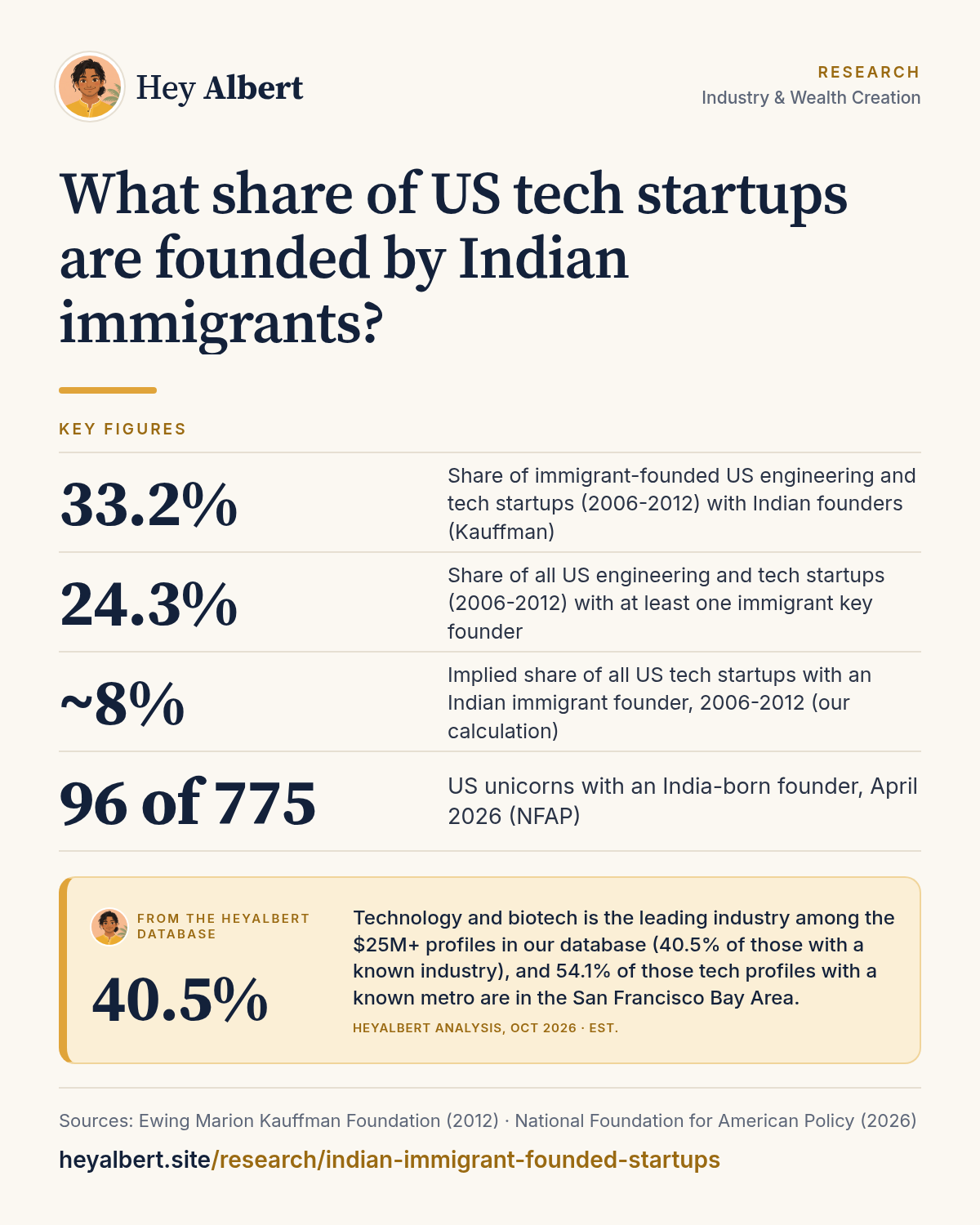
In the most detailed national study, Indian immigrants founded 33.2% of the immigrant-founded US engineering and technology startups launched between 2006 and 2012, more than immigrants from the next seven countries combined; since about a quarter of all such startups had an immigrant founder, that is roughly 8% of all US tech startups in the period1. More recent data on the most valuable startups point the same way: India-born founders appear in 96 of 775 US unicorns as of April 2026, the most of any country2.
HeyAlbert data shows technology and biotech is the leading industry among the $25M+ profiles in our database (40.5% of those with a known industry), and 54.1% of those tech profiles with a known metro are in the San Francisco Bay Area. See the data · Methodology
The best measure: Kauffman's immigrant entrepreneur studies
The question is usually answered with research led by Vivek Wadhwa, AnnaLee Saxenian and F. Daniel Siciliano for the Kauffman Foundation, which surveyed engineering and technology companies founded in the US and identified whether a key founder was foreign-born. Its 2012 report, the latest in the series, found that 24.3% of engineering and technology companies founded nationwide between 2006 and 2012 had at least one immigrant key founder, slightly down from 25.3% for 1995 to 20051.
Among those immigrant-founded companies, 33.2% had Indian founders, up about 7 percentage points from 2005, and Indians founded more such companies than immigrants from the next seven countries combined1.
| Country of origin | Share of immigrant-founded tech startups, 2006-2012 |
|---|---|
| India | 33.2% |
| China | 8.1% |
| United Kingdom | 6.3% |
| Canada | 4.2% |
| Germany | 3.9% |
| Israel | 3.5% |
Source: Kauffman Foundation, 20121.
Multiplying the two shares gives a rough estimate that about 8% of all US engineering and technology startups in that period had an Indian immigrant founder (our calculation from Kauffman's figures), at a time when Indian immigrants were around 1% of the US population; MPI counts about 3.2 million today1,4.
What HeyAlbert data shows
Silicon Valley: an even larger role
The concentration is highest in Silicon Valley. Kauffman found that 43.9% of Silicon Valley startups founded between 2006 and 2012 had at least one immigrant key founder, and its 2007 study had found that Indians accounted for 25.8% of immigrant-founded Silicon Valley startups between 1995 and 2005, far ahead of China and the UK at 5.4% each1. Nationally, 26% of Indian-founded companies in the 2012 sample were in California and 8% in Massachusetts1. Our profile of Indian Americans in Silicon Valley and the Bay Area looks at the population behind those numbers.
The billion-dollar end of the market
Kauffman's data stop in 2012, but the National Foundation for American Policy tracks the most valuable private startups today. As of April 2026, immigrants had founded or co-founded 455 of 775 US unicorns (59%), and India, with 96 companies, was the leading country of origin, ahead of Israel (60) and the United Kingdom (47)2. Six of the 15 immigrants who have founded two or more US unicorns were born in India2. The details, including the serial founders, are in how many billion-dollar startups have Indian-born founders, and the biggest liquidity events are in the largest IPOs and exits by Indian American founders.
Jobs and output
These companies are significant employers. Kauffman estimated that immigrant-founded engineering and technology companies started between 2006 and 2012 employed about 560,000 workers and generated $63 billion in revenue in 2012, across all countries of origin1. At the top of the market, NFAP finds that immigrant-founded unicorns employ an average of 833 people each, and those with a founder who first came to the US as an international student average 1,123 jobs2. Because Indian-born founders make up the largest single group in both datasets, they account for a meaningful share of those jobs, although neither study publishes a country-level employment total.
For founders, the financial reward usually arrives years later, through a sale, secondary transactions or an IPO. That timing explains why many Indian American founders show up first as high earners and only later as holders of significant wealth.
Why Indian immigrants start so many tech companies
The research points to a few drivers. Immigrants in general found firms at higher rates: a study co-authored by MIT economist Pierre Azoulay found that 0.83% of immigrants founded a firm between 2005 and 2010, against 0.46% of US-born citizens, making immigrants about 80% more likely to start a company3. Indian immigrants also arrive with unusually technical training; MPI reports that half hold a graduate or professional degree4. Many come as students or skilled workers and found companies after years inside US tech firms, a path described in the H-1B visa and Indian American wealth and the IIT and IIM route to US leadership.
Networks matter too. Organizations such as TiE, founded in Silicon Valley, connect founders with mentors and capital; see TiE, AAPI and other professional networks and Indian American angel investors. As earlier founders exit, many become investors in the next generation, covered in Indian American venture capitalists.
Caveats
The Kauffman figures come from a sample of companies and count founders by country of birth, so US-born children of Indian immigrants are not in the India share1. Its national counts are now more than a decade old, and no comparable official dataset has replaced them. Unicorn counts cover only the most valuable private companies, a small and unusual slice of all startups2.
Frequently asked questions
What percentage of US startups are founded by Indian immigrants?
In Kauffman Foundation research on engineering and technology startups founded in 2006-2012, Indian immigrants founded 33.2% of the immigrant-founded companies, or roughly 8% of all such startups. No newer national study measures the same thing.
Do Indian immigrants found more startups than other immigrant groups?
Yes. In the Kauffman data Indians founded more tech startups than immigrants from the next seven countries combined, and India leads all countries in US unicorn founders, with 96 companies as of April 2026.
Are immigrants more likely to start businesses?
Research co-authored by MIT economist Pierre Azoulay found immigrants are about 80% more likely than US-born citizens to found a firm.
Does the data include US-born Indian Americans?
No. Both the Kauffman and NFAP studies count founders by country of birth, so second-generation Indian American founders are not included in the India figures.
Sources
Figures are from the public sources below, with the data year stated. Estimates are labeled as estimates. Accessed October 24, 2026.
- Ewing Marion Kauffman Foundation, Then and Now: America's New Immigrant Entrepreneurs, Part VII (Wadhwa, Saxenian, Siciliano) (2012). kauffman.org ↩ ↩ ↩
- National Foundation for American Policy, Immigrants and U.S. Billion-Dollar Companies (NFAP Policy Brief, June 2026) (2026). nfap.com ↩ ↩ ↩
- MIT News, Study: Immigrants in the US are more likely to start firms, create jobs (2022). news.mit.edu ↩ ↩
- Migration Policy Institute, Indian Immigrants in the United States (Spotlight) (2026). migrationpolicy.org ↩ ↩