
Short answer
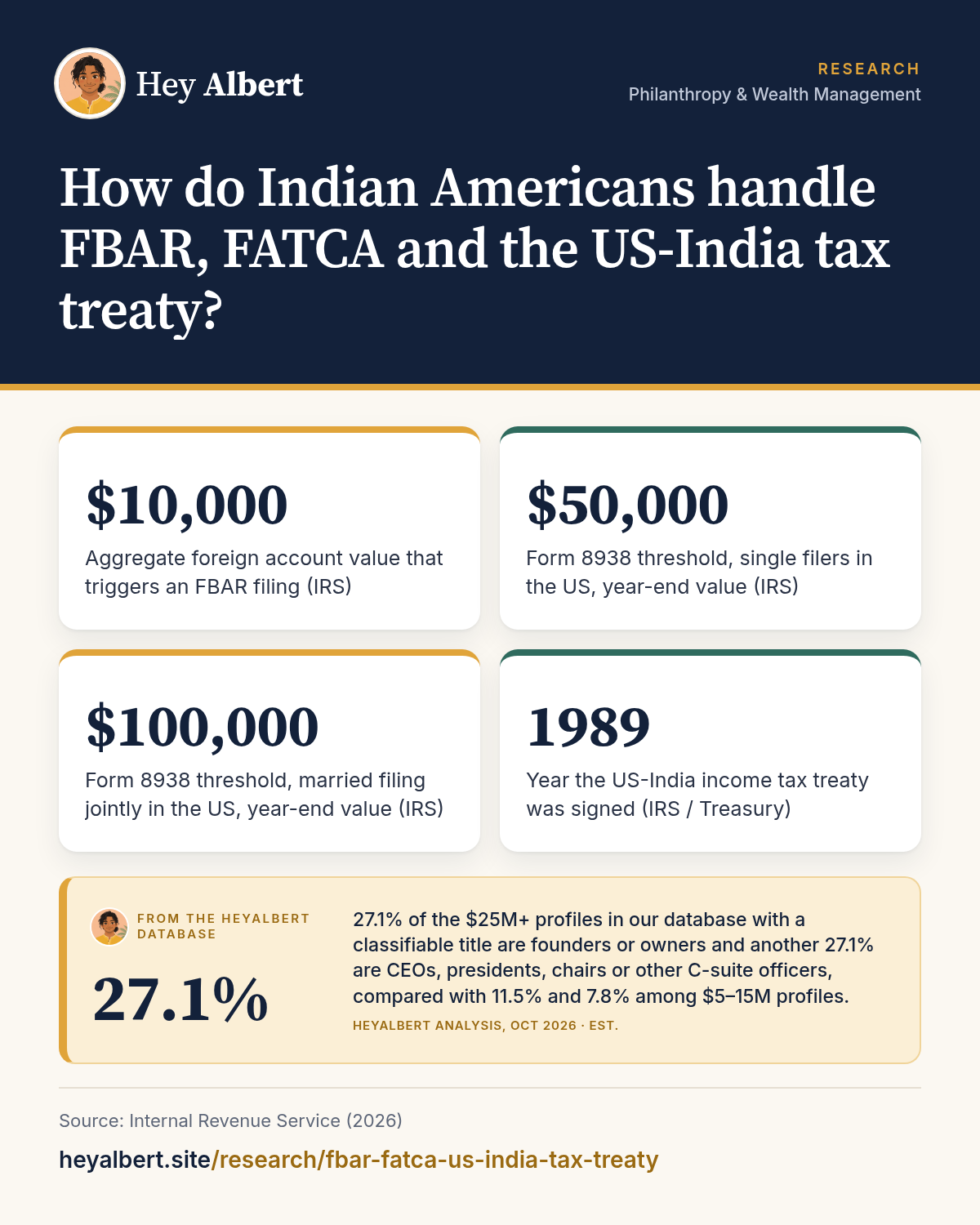
US citizens and residents with Indian bank or investment accounts must file an FBAR with FinCEN when their foreign accounts together exceed $10,000 at any time in the year, and may also need IRS Form 8938 under FATCA once foreign financial assets pass $50,000 (single filers living in the US)1,2. The US-India income tax treaty, signed in New Delhi in 1989, helps prevent double taxation, and since a 2015 agreement Indian banks report US account holders' information for exchange with the IRS3,4.
HeyAlbert data shows 27.1% of the $25M+ profiles in our database with a classifiable title are founders or owners and another 27.1% are CEOs, presidents, chairs or other C-suite officers, compared with 11.5% and 7.8% among $5–15M profiles. See the data · Methodology
Why this matters for Indian American families
About 69% of the 5.1 million people in the US who identify as Asian Indian were born abroad5, and many keep bank accounts, deposits, mutual funds or insurance policies in India. US citizens and resident aliens are taxed on their worldwide income6, and the US requires separate disclosure of foreign accounts and assets. Missing these filings is one of the most common and costly mistakes for families with assets in both countries. Our post on remittances from the US to India shows how large these cross-border flows are.
What HeyAlbert data shows
FBAR: the $10,000 test
The Report of Foreign Bank and Financial Accounts (FBAR), FinCEN Form 114, is required when a US person has a financial interest in, or signature authority over, foreign financial accounts whose aggregate value exceeded $10,000 at any time during the calendar year2. The test is cumulative: two accounts that together top $10,000 at any moment must both be reported1.
- Due date: April 15, with an automatic extension to October 15; no request is needed2
- Where: filed electronically through FinCEN's BSA E-Filing System, not with the tax return2
- Penalties: civil penalties are adjusted annually for inflation; the IRS notes that, for assessments before August 2016, non-willful violations carried penalties of up to $10,000 and willful violations up to the greater of $100,000 or 50% of account balances1
For families with NRE, NRO or FCNR deposits, joint accounts with parents in India, or demat brokerage accounts, the $10,000 threshold is easily crossed.
FATCA and Form 8938
The Foreign Account Tax Compliance Act (FATCA) added a second requirement, Form 8938, filed with the federal income tax return. Thresholds are higher and depend on filing status and where the taxpayer lives1:
| Taxpayer living in the US | Year-end value above | Or at any time above |
|---|---|---|
| Single or married filing separately | $50,000 | $75,000 |
| Married filing jointly | $100,000 | $150,000 |
Form 8938 covers more than bank accounts, including some foreign financial assets that are not accounts. Some items appear on only one form: the IRS lists foreign hedge funds and private equity funds as reportable on Form 8938 but not the FBAR, while foreign real estate held directly is reportable on neither1. That last point surprises many owners; see whether Indian Americans keep property in India.
India's side: banks report to the IRS
On July 9, 2015, the US and India signed an intergovernmental agreement to implement FATCA4. Under it, Indian financial institutions collect information on accounts held by US persons, which India exchanges with the US under the authority of the 1989 tax treaty4. In practice, this means Indian banks and fund houses ask US clients for tax documentation, and accounts that go unreported in the US may be visible to the IRS anyway.
Indian mutual funds and the PFIC problem
A frequent trap is Indian mutual funds. Under US rules, a foreign corporation is a passive foreign investment company (PFIC) if 75% or more of its gross income is passive or at least 50% of its assets produce passive income7. Many foreign pooled investment funds meet that test, and US shareholders of PFICs may have to file Form 8621 and face less favorable tax treatment7. Advisors working with Indian American clients often review Indian fund holdings for this reason. For how the community invests more broadly, see how Indian Americans invest.
The US-India tax treaty
The income tax convention between the US and India was signed in New Delhi on September 12, 19893,4. Like other US treaties, it sets rules on which country can tax different kinds of income and how double taxation is relieved. US taxpayers may also claim a foreign tax credit for income taxes paid abroad, subject to limits6. Treaty positions can be complex; the treaty and its technical explanation are published by the IRS3.
The income tax treaty does not cover estates, which creates separate questions for families with assets in both countries. We cover those in cross-border estate planning for Indian Americans. For how high-net-worth families organize this work, see Indian American family offices.
A note on this guide
This article summarizes publicly available IRS, FinCEN and Treasury guidance as of October 2026 and is not tax advice. Thresholds, forms and penalties change, and individual circumstances, such as residency status in either country, matter. Families with Indian accounts or assets should work with a professional who handles both US and Indian rules. Readers interested in the wider wealth-management picture can start with private foundations and donor-advised funds.
Frequently asked questions
Do I need to file an FBAR for my Indian bank account?
Yes, if you are a US person and the combined value of all your foreign financial accounts exceeded $10,000 at any time during the year. The FBAR is filed with FinCEN, not with your tax return.
What is the difference between FBAR and Form 8938?
The FBAR is filed with FinCEN and has a $10,000 aggregate threshold. Form 8938 is filed with your tax return under FATCA and has higher thresholds, starting at $50,000 for single filers living in the US, and covers some assets the FBAR does not.
Is there a tax treaty between the US and India?
Yes. The US-India income tax convention was signed in New Delhi on September 12, 1989. It addresses double taxation of income; it does not cover estate taxes.
Do Indian banks report US account holders to the IRS?
Under a FATCA intergovernmental agreement signed in July 2015, Indian financial institutions collect information on US account holders, which India exchanges with the United States.
Are Indian mutual funds a problem for US taxpayers?
They can be. Many foreign pooled funds meet the IRS definition of a passive foreign investment company, which can require Form 8621 and result in less favorable US tax treatment.
Sources
Figures are from the public sources below, with the data year stated. Estimates are labeled as estimates. Accessed October 24, 2026.
- Internal Revenue Service, Comparison of Form 8938 and FBAR requirements (2026). irs.gov ↩ ↩ ↩
- Internal Revenue Service, Report of Foreign Bank and Financial Accounts (FBAR) (2026). irs.gov ↩ ↩ ↩
- Internal Revenue Service, India – Tax Treaty Documents (2026). irs.gov ↩ ↩ ↩
- US Department of the Treasury, Agreement between the US and India to Improve International Tax Compliance and to Implement FATCA (July 9, 2015) (2015). home.treasury.gov ↩ ↩ ↩
- US Census Bureau, S0201 Selected Population Profile, Asian Indian alone, United States (ACS 2024 1-year) (2025). data.census.gov ↩
- Internal Revenue Service, Frequently asked questions about international individual tax matters (2026). irs.gov ↩ ↩
- Internal Revenue Service, Instructions for Form 8621 (12/2025) (2025). irs.gov ↩ ↩