
Short answer
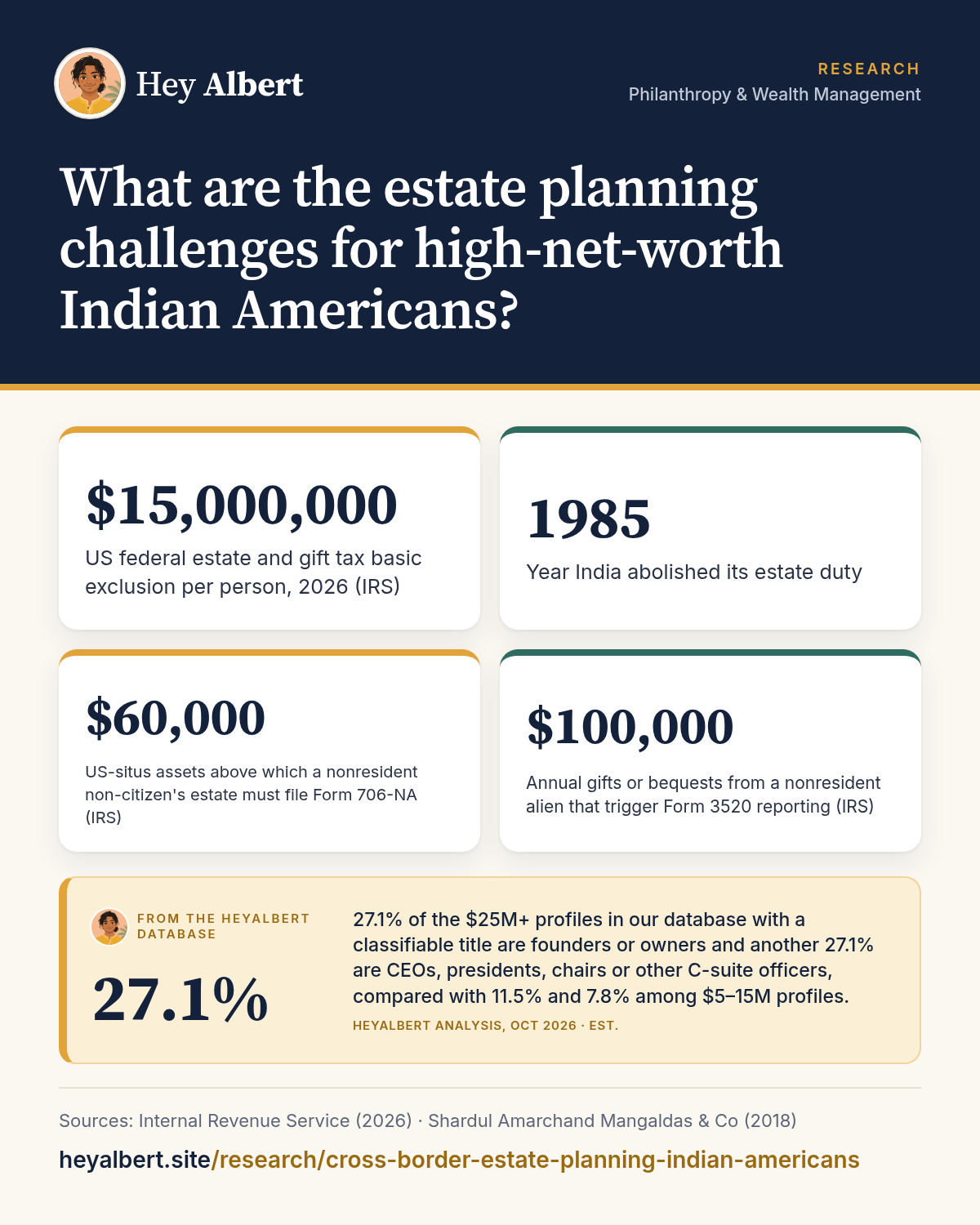
The main challenges come from straddling two systems. US citizens and residents face federal estate tax on worldwide assets above a $15 million exclusion per person in 20261, while India abolished its estate duty in 19852 and there is no US-India estate tax treaty3. Families also deal with non-citizen spouses, inherited property in India subject to Indian foreign-exchange rules, US reporting of large gifts and inheritances from abroad, and a mostly US-born next generation4,5,1.
HeyAlbert data shows 27.1% of the $25M+ profiles in our database with a classifiable title are founders or owners and another 27.1% are CEOs, presidents, chairs or other C-suite officers, compared with 11.5% and 7.8% among $5–15M profiles. See the data · Methodology
Two countries, two very different systems
For a wealthy Indian American family, estate planning usually involves assets in both the US and India: homes, businesses, deposits, investments and inherited family property. The two countries treat death very differently.
- United States: US citizens are subject to estate tax on their worldwide assets, even if they live abroad6. For 2026, the basic exclusion amount is $15,000,000 per person, set by the law signed on July 4, 20251. Married couples can pass a deceased spouse's unused exclusion to the survivor by election1.
- India: India had an estate duty under a 1953 law, with rates as high as 85%, but abolished it in 19852. India currently has no estate or inheritance tax.
There is no estate tax treaty between the US and India. The IRS lists 15 countries with US estate or gift tax treaties, including the UK, Japan and Germany, and India is not among them3. The US-India income tax treaty, covered in our FBAR, FATCA and treaty guide, addresses income, not estates.
What HeyAlbert data shows
Challenge 1: the non-citizen spouse
Many Indian American households include a spouse who is a green card holder or Indian citizen rather than a US citizen. That matters because the unlimited marital deduction available between US-citizen spouses does not apply in the same way. IRS guidance requires a gift tax return when outright gifts to a non-citizen spouse in a year exceed a set limit, currently stated as $190,000, an amount indexed for inflation4. Planning tools for non-citizen spouses exist, but they need to be set up deliberately and in advance.
Challenge 2: property and inheritances in India
Assets in India pass under Indian succession law and Indian foreign-exchange rules. The Reserve Bank of India allows non-residents, including OCI cardholders, to inherit any immovable property, including agricultural land that they could not buy7. Getting proceeds out later is limited: repatriation of certain inherited assets is allowed up to USD 1 million per financial year7.
On the US side, a US person who receives gifts or bequests from a nonresident alien, such as a parent in India, must report them on Form 3520 if they total more than $100,000 in a year5. The inheritance itself is generally not income, but missing the filing can lead to penalties. We look at property holdings in whether Indian Americans keep property in India.
Challenge 3: family members who are not US persons
Parents or siblings living in India who hold US assets, such as a US brokerage account or a property bought for a child, face a different rule. The estate of a nonresident who is not a US citizen must file a US estate tax return if US-situs assets exceed $60,000 at death6, a far lower threshold than the exclusion for citizens. Families who move money between generations across borders often overlook this.
Challenge 4: businesses and succession
Many of the wealthiest Indian American families own operating businesses: hotels, healthcare practices, IT services firms, real estate. Passing them on raises valuation, control and fairness questions among siblings, some of whom may work in the business and some not. Our research on Indian American family businesses and hotel ownership covers the assets most often involved.
What a cross-border plan usually covers
Advisors who work with these families tend to start with an inventory: what is owned, where, in whose name and under which country's rules. From there the questions follow. Which assets should be governed by a US will or trust and which by an Indian will? Who are the executors in each country, and can they act quickly? Are Indian accounts and inheritances being reported correctly in the US? Is a non-citizen spouse protected? How will an operating business pass, and to whom?
None of this is unusual for an affluent family with roots in two countries, but each answer depends on facts that change over time, such as citizenship, residency and where children settle. Plans are best reviewed when any of those change.
Challenge 5: a US-born next generation
About 69% of Asian Indians in the US were born abroad8, but their children are mostly US-born and may have little connection to property or accounts in India. That can change what heirs want: a US-born heir may have little use for an apartment in India and more interest in assets that are easy to hold and manage from the US. Charitable structures are another lever, discussed in private foundations and donor-advised funds, and the wealth transfer itself is the subject of intergenerational wealth transfer among Indian Americans.
This article summarizes public IRS, RBI and legal sources as of October 2026 and is not legal or tax advice; cross-border estates require advisors qualified in both jurisdictions. See also how family offices serve Indian American families.
Frequently asked questions
Does India have an estate or inheritance tax?
No. India abolished its estate duty in 1985 and currently has no estate or inheritance tax, though income and capital gains on inherited assets can still be taxed.
Is there a US-India estate tax treaty?
No. The United States has estate or gift tax treaties with 15 countries, and India is not one of them. The US-India treaty covers income taxes only.
What is the US estate tax exemption in 2026?
The basic exclusion amount is $15,000,000 per person for 2026, according to the IRS. Married couples can transfer a deceased spouse's unused exclusion to the survivor by election.
Do I have to report an inheritance from my parents in India?
If you are a US person and receive gifts or bequests from a nonresident alien totaling more than $100,000 in a year, you must report them on IRS Form 3520. The inheritance is generally not taxable income, but the filing is required.
Sources
Figures are from the public sources below, with the data year stated. Estimates are labeled as estimates. Accessed October 24, 2026.
- Internal Revenue Service, What's new — Estate and gift tax (2026). irs.gov ↩ ↩ ↩
- Shardul Amarchand Mangaldas & Co, Estate Duty Act (report) (2018). amsshardul.com ↩ ↩ ↩
- Internal Revenue Service, Estate & gift tax treaties (international) (2026). irs.gov ↩ ↩
- Internal Revenue Service, Gifts & Inheritances FAQ (2026). irs.gov ↩ ↩
- Internal Revenue Service, Gifts from foreign person (2026). irs.gov ↩ ↩ ↩
- Internal Revenue Service, Some nonresidents with U.S. assets must file estate tax returns (2026). irs.gov ↩ ↩ ↩
- Reserve Bank of India, FAQs: Acquisition and Transfer of Immovable Property in India by NRIs/OCIs (2026). rbi.org.in ↩ ↩
- US Census Bureau, S0201 Selected Population Profile, Asian Indian alone, United States (ACS 2024 1-year) (2025). data.census.gov ↩