
Short answer
The H-1B visa has been the main entry point for skilled Indian professionals: 70% of the 406,348 H-1B petitions USCIS approved in fiscal 2025 were for workers born in India, at a median offered salary of $133,0001. That pipeline of highly educated, well-paid workers, many of whom later became green-card holders, executives and founders, helps explain why households headed by Indian immigrants had a median income of $176,200 in 20243.
HeyAlbert data shows technology and biotech is the leading industry among the $25M+ profiles in our database (40.5% of those with a known industry), and 54.1% of those tech profiles with a known metro are in the San Francisco Bay Area. See the data · Methodology
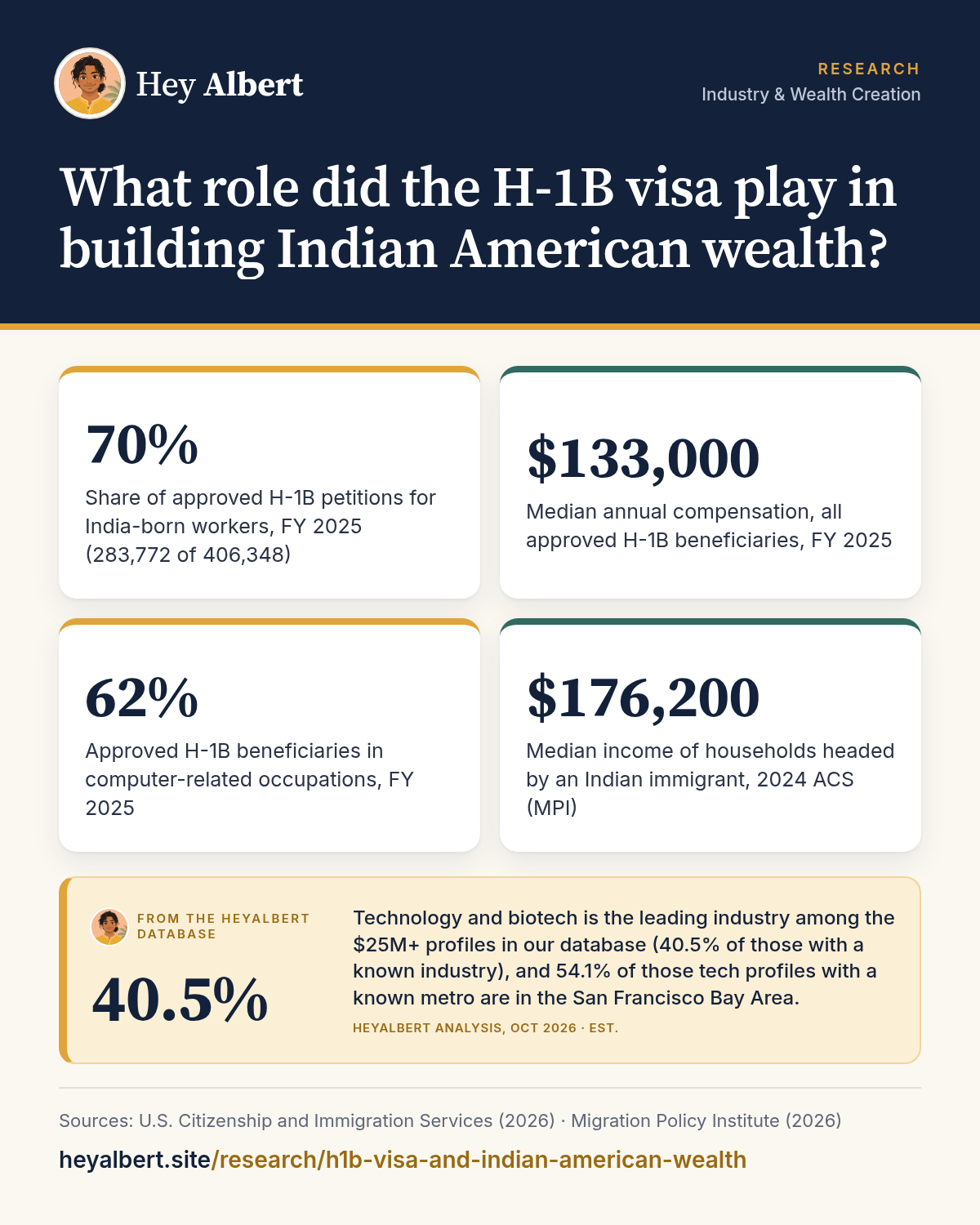
India-born workers dominate the H-1B program
The H-1B is a temporary visa for "specialty occupations" that require at least a bachelor's degree. In fiscal 2025, USCIS approved 406,348 H-1B petitions, and 283,772 of them, or 70%, were for beneficiaries born in India; China was a distant second at about 12%1. That pattern is long-standing: Pew Research Center reports that a majority of H-1B approvals every year since 2010 have gone to India-born workers2.
The visa selects for exactly the traits that produce high incomes. Of all approved FY 2025 beneficiaries, 62% worked in computer-related occupations, and 57.5% held a master's degree as their highest degree, with another 8.1% holding doctorates1.
| H-1B approvals, FY 2025 | Figure |
|---|---|
| Total approved petitions | 406,348 |
| Born in India | 283,772 (70%) |
| Computer-related occupations | 62% |
| Master's degree as highest degree | 57.5% |
| Median offered compensation | $133,000 |
Source: USCIS, FY 2025 report to Congress1.
What HeyAlbert data shows
From salary to wealth: how the H-1B path compounds
Median annual compensation for all approved H-1B beneficiaries was $133,000 in FY 2025, and those with professional degrees had a median of $205,0001. Pay rises with tenure: for every education level, workers on continuing-employment petitions were offered more than those on initial petitions1. USCIS notes these are the salaries employers stated when filing, not verified earnings1.
Salary is only the first layer. Many H-1B workers are employed by large technology companies whose pay packages include stock, and years of vesting can turn a professional salary into substantial household wealth; our guide to equity compensation for Indian American tech executives explains how. Household structure matters as well: the visa population is heavily weighted toward graduate-educated, dual-professional couples, the profile behind Indian American median household income.
The Migration Policy Institute's tabulation of 2024 Census data shows the outcome at the population level. Households headed by an Indian immigrant had a median income of $176,200, against $81,400 for households headed by someone born in the US; 82% of Indian immigrants aged 25 and older held at least a bachelor's degree and 50% held an advanced degree3. The gap with later generations is covered in foreign-born vs US-born Indian Americans.
The H-1B as a launch pad for founders
The US has no dedicated startup visa, so most immigrant founders first worked as employees, typically on an H-1B, before founding, according to the National Foundation for American Policy6. NFAP found that 24% of US billion-dollar startups (183 of 775) have a founder who first came to America as an international student, and that international students typically can stay long-term only after obtaining H-1B status or a green card6. India-born founders lead all countries, with 96 US unicorns, as detailed in our analysis of Indian-born unicorn founders; the broader startup picture is in the share of US startups founded by Indian immigrants.
The pipeline usually starts earlier, at university. MPI reports that more than 363,000 Indian students were enrolled in US higher education in the 2024-25 school year, 31% of all international students and more than from any other country3. Many arrive after undergraduate degrees in India, a path traced in the IIT and IIM route to US executive roles.
IT services firms and the H-1B
Outsourcing and IT services firms have historically been among the largest H-1B sponsors. Pew reports that in 2023 three of the top 10 H-1B employers were Infosys and Tata Consultancy Services, both headquartered in India, and Cognizant, which originated in India and is now US-headquartered, down from six India-linked firms in the top 10 in 20162. Our piece on Indian American IT services and staffing firms looks at the companies and the founders who built them.
The green card bottleneck
Turning a temporary H-1B into permanent residence is slow for Indian nationals. US law caps the number of family and employment preference green cards going to natives of any one country at 7% of the annual total, and USCIS has said the agencies already hold enough EB-2 and EB-3 applications from India to use all available visas for several fiscal years ahead5. The overall employment-based limit is about 140,000 a year when no unused family numbers carry over5. Even so, MPI reports that 37% of Indians who received a green card in fiscal 2023 did so through employment-based categories, more than double the share among all new green-card holders3.
Long waits shape financial decisions: workers on temporary status may defer buying homes, changing employers or starting companies, which is one reason the green card often marks the point at which careers branch into entrepreneurship.
A changing policy landscape
The program has tightened. A presidential proclamation that took effect on September 21, 2025 restricted entry for new H-1B workers unless the petition was accompanied by a $100,000 payment, with limited exceptions; in September 2026 the White House extended it for another 12 months, to September 21, 2027, and reported that the payment had been made for more than 700 petitions4. MPI notes that Indian nationals have been particularly affected by the fee, enhanced vetting and longer visa-interview waits3. The long-run effect on the next generation of Indian American wealth is an open question we track in the future of Indian American wealth.
Frequently asked questions
What share of H-1B visas go to Indians?
In fiscal 2025, 70% of approved H-1B petitions were for workers born in India, according to USCIS. A majority of approvals have gone to India-born workers every year since 2010, Pew Research Center reports.
How much do H-1B workers earn?
The median offered salary for all approved H-1B beneficiaries was $133,000 in fiscal 2025. Workers with professional degrees had a median of $205,000. These are employer-stated salaries at filing, not verified earnings.
Why do Indian H-1B workers wait so long for green cards?
US law limits any single country to 7% of family and employment preference green cards each year. Because demand from India far exceeds that share, Indian EB-2 and EB-3 applicants face multi-year backlogs.
What is the $100,000 H-1B fee?
A September 2025 presidential proclamation requires a $100,000 payment with most new H-1B petitions for workers outside the US. It was extended in September 2026 to run until September 21, 2027.
Sources
Figures are from the public sources below, with the data year stated. Estimates are labeled as estimates. Accessed October 24, 2026.
- US Citizenship and Immigration Services, Characteristics of H-1B Specialty Occupation Workers, Fiscal Year 2025 Annual Report to Congress (2026). uscis.gov ↩ ↩ ↩
- Pew Research Center, What we know about the U.S. H-1B visa program (2025). pewresearch.org ↩ ↩
- Migration Policy Institute, Indian Immigrants in the United States (Spotlight) (2026). migrationpolicy.org ↩ ↩ ↩
- The White House, Restriction on Entry of Certain Nonimmigrant Workers (proclamation extending the 2025 H-1B restriction) (2026). whitehouse.gov ↩
- US Citizenship and Immigration Services, Employment-Based Adjustment of Status FAQs (2023). uscis.gov ↩ ↩
- National Foundation for American Policy, Immigrants and U.S. Billion-Dollar Companies (NFAP Policy Brief, June 2026) (2026). nfap.com ↩ ↩ ↩