
Short answer
The United States is now the single largest source of remittances to India, accounting for 27.7% of India's inward remittances in fiscal 2023-24, up from 23.4% in 2020-211. Applied to India's $118.7 billion in remittances that year1, that share works out to roughly $33 billion sent from the US, a HeyAlbert estimate. India as a whole received a record $151 billion in personal remittances in 2025, according to World Bank data2.
HeyAlbert data shows California holds 30.4% of the $25M+ profiles in our database with a known state, followed by New York and Texas (14.4% each); among $5–15M profiles, California's share is 50.2%. See the data · Methodology
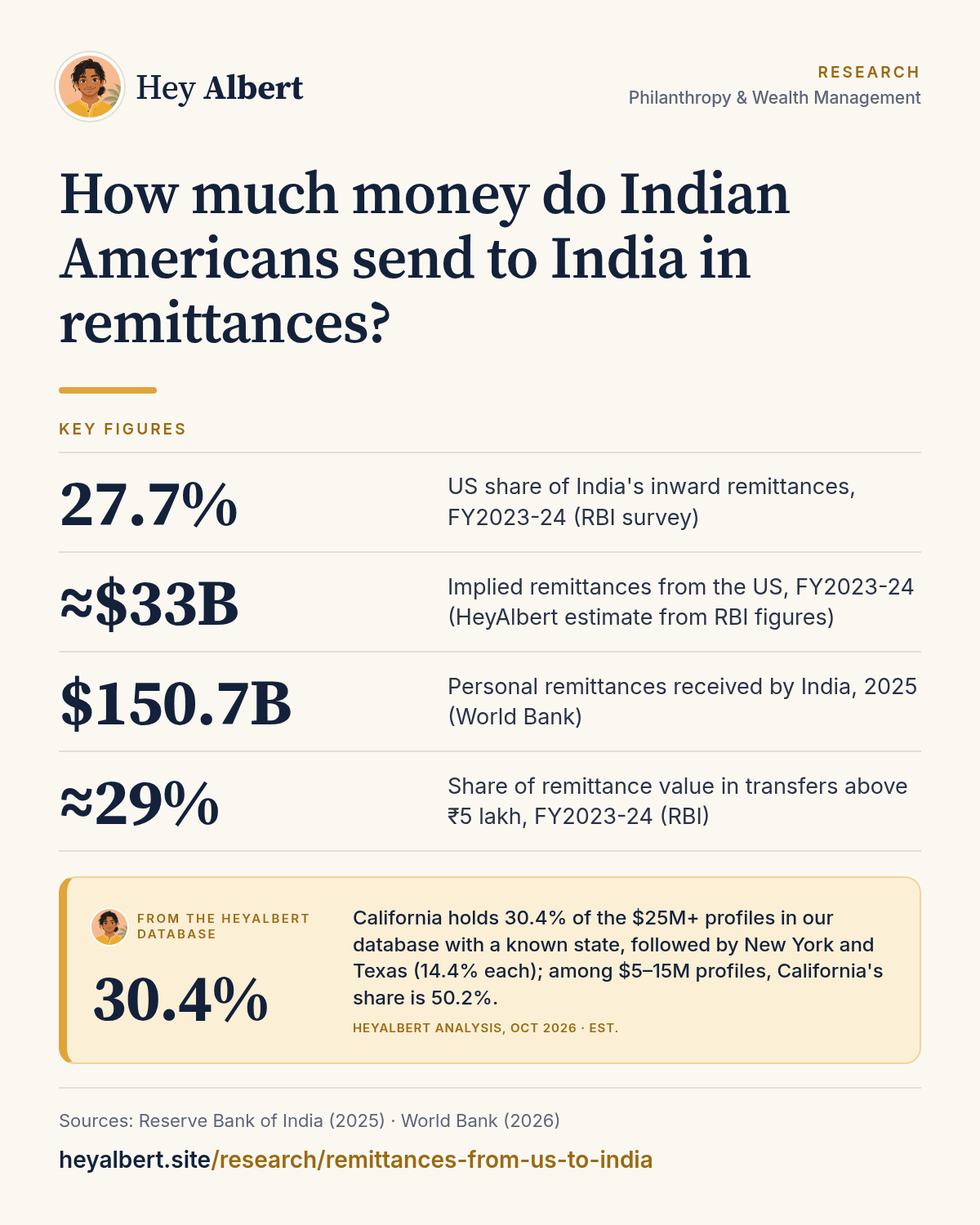
The short answer: the US is India's biggest remittance corridor
India has been the world's largest recipient of remittances since 2008, and its share of global remittances rose from about 11% in 2001 to about 14% in 2024, according to the Reserve Bank of India (RBI)1. World Bank data put India's personal remittances received at $137.7 billion in 2024 and $150.7 billion in 20252.
Where that money comes from has shifted. The RBI's sixth remittances survey, which covered banks handling about 99% of inward remittances for family maintenance and savings, found the United States supplied 27.7% of India's inward remittances in fiscal 2023-24, up from 23.4% in 2020-21 and 22.9% in 2016-171. The US overtook the United Arab Emirates, whose share was 19.2%1.
Neither the RBI nor the World Bank publishes an official dollar figure for the US-to-India corridor alone. Applying the RBI's 27.7% share to India's $118.7 billion in total remittances for 2023-241 gives roughly $33 billion. That figure is our estimate, not an official statistic.
What HeyAlbert data shows
Why the corridor has grown: a shift toward skilled migration
The RBI attributes the change to a migration pattern tilting toward skilled workers in advanced economies. Its survey found that remittances from advanced economies, led by the US, the UK, Singapore, Canada and Australia, together made up more than half of India's remittances in 2023-24, surpassing the Gulf countries1.
| Source country | 2016-17 | 2020-21 | 2023-24 |
|---|---|---|---|
| United States | 22.9% | 23.4% | 27.7% |
| United Arab Emirates | 26.9% | 18.0% | 19.2% |
| United Kingdom | 3.0% | 6.8% | 10.8% |
| Saudi Arabia | 11.6% | 5.1% | 6.7% |
| Singapore | 5.5% | 2.4% | 6.6% |
Share of India's inward remittances by source country, RBI survey1.
That fits the profile of the US diaspora. Census data show Asian Indian households had a median income of $165,721 in 2024, about twice the US median of $81,6044, and about 69% of the 5.1 million people who identify as Asian Indian alone were born abroad4. A large, high-earning, mostly first-generation population is exactly the group that sends money home. For the income picture, see our breakdown of Indian American household income and how foreign-born and US-born Indian Americans compare.
Large transfers, not just small ones
Remittances are often pictured as small monthly transfers. The RBI data show a more mixed pattern. By number, the most common transfers to India are under $200. By value, transfers of more than ₹5 lakh made up the largest share, around 29%, in 2023-241.
Large transfers fit a wealthier sending population. Money moving from the US to India often funds property purchases, deposits in non-resident accounts, family support and investments, not just household expenses. The RBI notes that India's personal transfers include local withdrawals from non-resident deposit accounts as well as money sent for family maintenance1. We look at the property side in whether wealthy Indian Americans keep homes and invest in India.
Where the money goes in India
Remittances are concentrated in a handful of Indian states. In 2023-24, Maharashtra received 20.5% of India's inward remittances, Kerala 19.7%, Tamil Nadu 10.4%, Telangana 8.1% and Karnataka 7.7%, according to the RBI survey1. The survey does not break destination states down by source country, so it does not show which states receive the most money from the US specifically.
At the national level, remittances have hovered around 3% of India's GDP since 20001, and the RBI says net remittance receipts have financed around half of India's merchandise trade deficit1.
The new US remittance tax and what it changes
Since January 1, 2026, a 1% federal excise tax applies to remittances sent from the US to recipients abroad when the sender pays the provider with cash, a money order, a cashier's check or a similar physical instrument3. Senders are liable, and providers collect the tax and file quarterly returns. Treasury and the IRS issued proposed regulations in April 20263.
Because the tax targets physical instruments, transfers funded from a bank account are outside its stated scope as the IRS describes it3. Many higher-income senders already move money digitally, so the tax is likely to matter more for cash-based senders than for affluent households. That is our reading, not an official estimate. For the wider tax picture affecting families with assets in both countries, see our guide to FBAR, FATCA and the US-India tax treaty.
What remittances say about wealth and giving
Remittances are only one way money moves from the US diaspora to India. Others include direct investment in startups and real estate, gifts to Indian universities and charities, and family support that is never recorded as a remittance. Some of that giving runs through US structures. We cover it in our research on Indian American philanthropy and private foundations and donor-advised funds.
For advisors, the size of the corridor matters for a practical reason. Clients who send meaningful sums to India each year have cross-border cash-flow, tax and estate questions that domestic-only planning misses, a theme we develop in cross-border estate planning for Indian Americans.
Family events are part of that flow too, from contributions to weddings in India to multi-day celebrations in the US; see what Indian American families spend on weddings.
Frequently asked questions
Which country sends the most remittances to India?
The United States. It accounted for 27.7% of India's inward remittances in fiscal 2023-24, ahead of the UAE at 19.2%, according to the Reserve Bank of India's sixth remittances survey.
How much money is sent from the US to India each year?
There is no official figure for this corridor alone. Applying the RBI's 27.7% US share to India's $118.7 billion in 2023-24 remittances gives roughly $33 billion, which is an estimate.
How much did India receive in remittances in 2025?
World Bank data show India received about $150.7 billion in personal remittances in 2025, up from about $137.7 billion in 2024, keeping it the world's largest recipient.
Is there a US tax on sending money to India?
Since January 1, 2026, a 1% federal excise tax applies to remittances funded with cash, money orders, cashier's checks or similar physical instruments. The IRS describes the tax as tied to those physical payment methods.
Sources
Figures are from the public sources below, with the data year stated. Estimates are labeled as estimates. Accessed October 24, 2026.
- Reserve Bank of India, Changing Dynamics of India's Remittances – Insights from the Sixth Round of India's Remittances Survey (RBI Bulletin, March 2025) (2025). rbi.org.in ↩ ↩ ↩
- World Bank, Personal remittances, received (current US$) – India (2026). data.worldbank.org ↩ ↩ ↩
- Internal Revenue Service, Treasury, IRS issue proposed regulations on the new remittance transfer tax (IR-2026-48) (2026). irs.gov ↩ ↩ ↩
- US Census Bureau, S0201 Selected Population Profile, Asian Indian alone, United States (ACS 2024 1-year) (2025). data.census.gov ↩ ↩