
Short answer
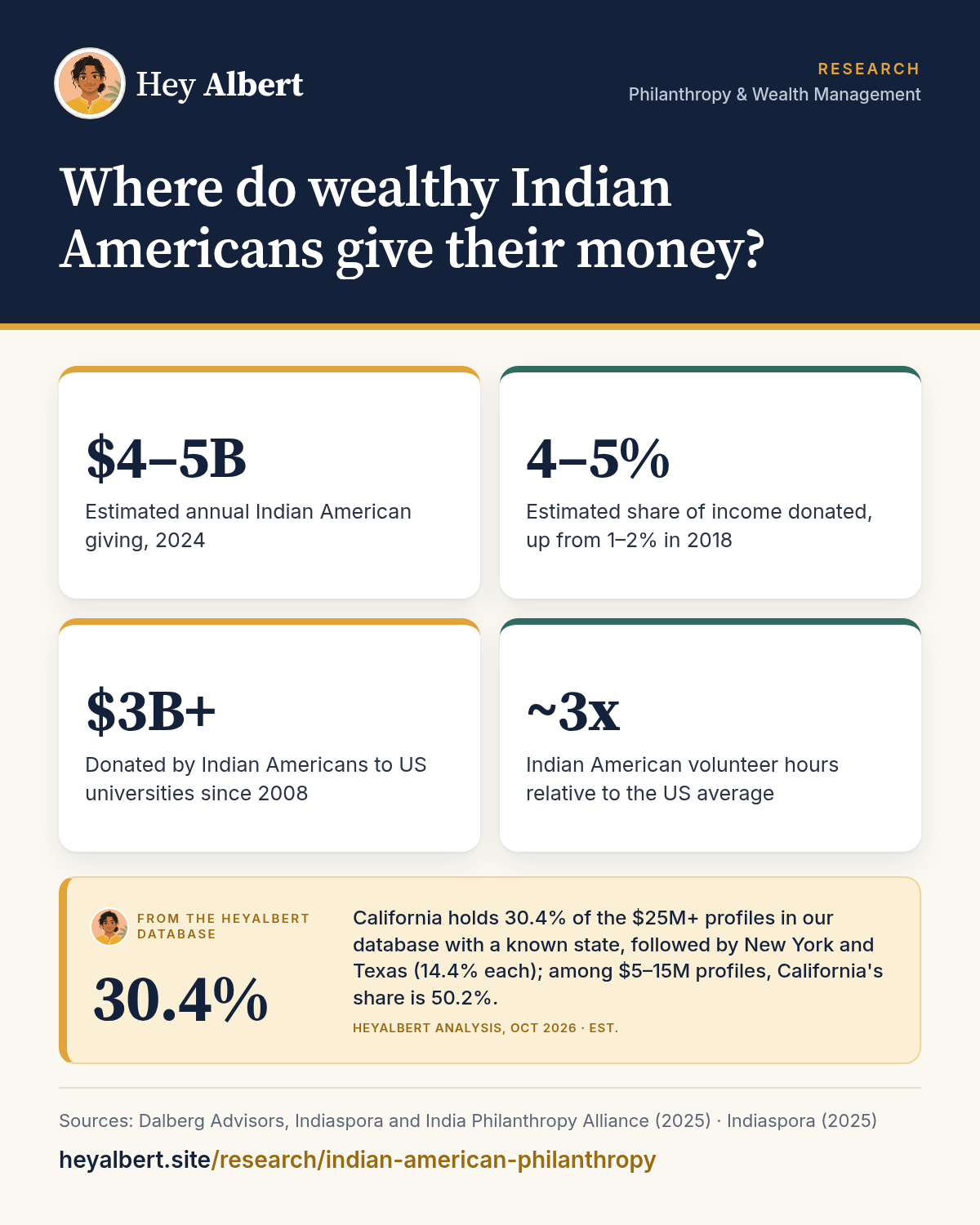
Indian Americans gave an estimated $4–5 billion in 2024, nearly triple the 2018 level, according to Dalberg, Indiaspora and the India Philanthropy Alliance1,2. The largest public gifts go to higher education: more than $3 billion to US universities since 2008, mostly to medicine and health sciences, engineering and business3. Substantial giving also goes to development causes in India and to local US causes5.
HeyAlbert data shows California holds 30.4% of the $25M+ profiles in our database with a known state, followed by New York and Texas (14.4% each); among $5–15M profiles, California's share is 50.2%. See the data · Methodology
How much Indian Americans give
The most detailed estimate comes from a 2025 study by Dalberg Advisors, Indiaspora and the India Philanthropy Alliance. Drawing on a survey of more than 400 Indian Americans and national income data, it estimates that the community gave $4–5 billion in 2024. It finds that donations rose to 4–5% of income, from 1–2% in 20181. The study attributes part of the rise to higher incomes. It says the main driver was a deeper commitment to giving, especially among higher-income donors, who now give a larger share of their income than the US average2.
The authors estimate a remaining annual "giving gap" of about $1 billion between potential and actual giving, down from $2–3 billion in 20182. Indian Americans also volunteer heavily, at nearly three times the US average in hours1. These are survey-based estimates, not tax-return totals, and should be read as orders of magnitude.
What HeyAlbert data shows
Higher education: the most visible destination
Universities attract the largest named gifts. Indiaspora reports that Indian Americans have donated more than $3 billion to US universities since 2008. The vast majority of publicly known donations went to medical and health sciences, engineering, and business education3. Another $140 million has gone to cultural programming, including centers for India studies and South Asian studies3.
Landmark examples include Chandrika and Ranjan Tandon's $100 million gift to New York University in 2015, after which the engineering school was renamed for them6. In 2017 the Patel Family Foundation, led by Tampa cardiologist Dr. Kiran Patel and Dr. Pallavi Patel, made a $200 million commitment to Nova Southeastern University: a $50 million gift plus a $150 million investment in real estate and facilities7. Our list of the largest Indian American gifts to US universities ranks these and other gifts.
Giving to India
Many donors also support development work in India. The India Philanthropy Alliance, a coalition of US nonprofits working in India, launched an annual India Giving Day campaign in 2023 to grow diaspora giving to these causes5. The Dalberg study found what it calls passion-donation mismatches. Donors say they care about causes such as gender equality and climate change but give relatively little to them1. Giving to India often sits beside other cross-border financial ties, including remittances to family in India and property held in India.
Indiaspora has also pushed more giving to local US causes, including hunger relief, programs for at-risk adolescent boys, and higher education5.
Billionaire pledges and private foundations
At the top end, several Indian American billionaires have signed the Giving Pledge, committing to give away most of their wealth. US-based signatories include Romesh and Kathleen Wadhwani, Vinod and Neeru Khosla, Bharat Desai and Neerja Sethi, Aneel and Allison Bhusri, Manoj Bhargava, and Jessica Schantz Taneja and Hemant Taneja4. Most large donors give through structured vehicles, usually a private family foundation or a donor-advised fund. Gifts are often timed around liquidity events such as an IPO or company sale.
Our guides to private foundations and donor-advised funds and to how wealthy Indian Americans run family offices explain these structures. The people behind the largest fortunes are profiled in our ranking of the richest Indian Americans.
Religious, cultural and community institutions
A large share of everyday giving goes to temples, gurdwaras, mosques, churches and cultural associations. They serve as community centers as well as places of worship. National data on these gifts is thin, because many are small and not publicly reported. They are an important part of household giving even where they do not show up in headline studies.
Professional and alumni networks are a second channel. Physician associations, entrepreneur networks and university alumni groups often run their own fundraising, and many large gifts start inside them. Our research on TiE, AAPI and other professional networks describes how they work.
What comes next
The Dalberg study projects that Indian American ultra-high-net-worth individuals will hold more than $1 trillion in wealth by 2030. It estimates that nearly $2 trillion will pass to the next generation over the next two decades1. If that generation gave 1% of inherited wealth a year, the authors estimate annual giving of about $20 billion2. The study finds that nearly a quarter of next-generation respondents have never been asked to give to causes they care about. Giving circles appeal to 24% of next-generation donors and 33% of next-generation women2. Our research on intergenerational wealth transfer and on the future of Indian American wealth explores those shifts.
Frequently asked questions
How much do Indian Americans donate each year?
A 2025 study by Dalberg, Indiaspora and the India Philanthropy Alliance estimates $4–5 billion in 2024, roughly triple the 2018 level, or about 4–5% of income.
What causes do wealthy Indian Americans support most?
The largest public gifts go to universities, especially medicine and health sciences, engineering and business schools. Development causes in India, local US causes, and religious and cultural institutions are also major recipients.
Which Indian Americans have signed the Giving Pledge?
US-based signatories include Romesh and Kathleen Wadhwani, Vinod and Neeru Khosla, Bharat Desai and Neerja Sethi, Aneel and Allison Bhusri, Manoj Bhargava, and Jessica Schantz Taneja and Hemant Taneja.
Is Indian American giving growing?
Yes. Estimated giving nearly tripled between 2018 and 2024, and the estimated gap between giving potential and actual giving shrank from $2–3 billion to about $1 billion a year.
Sources
Figures are from the public sources below, with the data year stated. Estimates are labeled as estimates. Accessed October 24, 2026.
- Dalberg Advisors, Indiaspora and India Philanthropy Alliance, From Closing the Gap to Setting the Standard: The State of Philanthropic Giving in the Indian American Diaspora (2025). dalberg.com ↩ ↩ ↩
- Dalberg Advisors, Indian American Philanthropy Narrows Giving Gap from $2–3 Billion to Just $1 Billion (press release) (2025). dalberg.com ↩ ↩ ↩
- Indiaspora, From Students to Benefactors: Indian Americans' $3 Billion Investment in American Universities (2025). indiaspora.org ↩ ↩ ↩
- The Giving Pledge, Pledger List (2026). givingpledge.org ↩
- Indiaspora, Growing Indian Diaspora Philanthropy: Building on Success from a Decade of Focused Effort (2025). indiaspora.org ↩ ↩ ↩
- NYU Tandon School of Engineering, Engineering Transformed (2015). engineering.nyu.edu ↩
- Nova Southeastern University, Nova Southeastern University Receives $200 Million Commitment from Patel Family Foundation (2017). news.nova.edu ↩