
Short answer
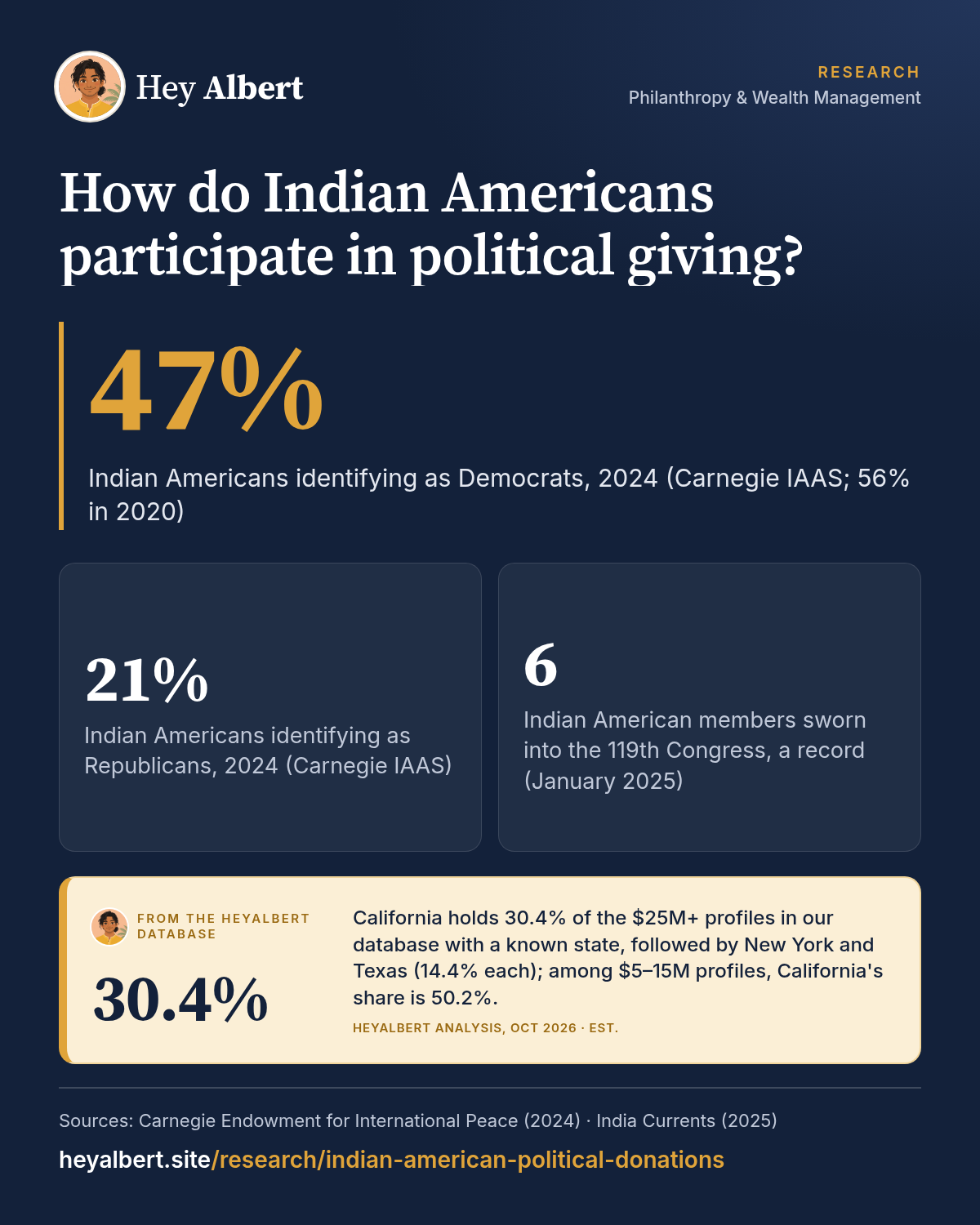
Indian Americans have become a visible force in US politics as voters, candidates and donors. In a 2024 Carnegie Endowment survey, 47% identified as Democrats and 21% as Republicans, down from 56% Democratic in 20201. A record six Indian Americans were sworn into the House in January 20252. Their giving follows the same federal rules as everyone's: individuals may give a candidate up to $3,500 per election in 2025-2026, and green card holders may contribute while other non-citizens may not3,4.
HeyAlbert data shows California holds 30.4% of the $25M+ profiles in our database with a known state, followed by New York and Texas (14.4% each); among $5–15M profiles, California's share is 50.2%. See the data · Methodology
A community with growing political weight
Indian Americans are one of the fastest-growing and highest-earning groups in the US. Asian Indian households had a median income of $165,721 in 2024, about twice the national median of $81,6045. That economic profile, and the community's concentration in politically important states such as Texas, Georgia, Pennsylvania and Michigan, has made it a target for outreach by both major parties.
Representation has grown alongside. When the 119th Congress was sworn in, six Indian American members took seats in the House, a record: Ami Bera, Pramila Jayapal, Ro Khanna, Raja Krishnamoorthi, Suhas Subramanyam and Shri Thanedar2. For the economic profile behind this, see whether Indian Americans are the richest ethnic group in the US.
What HeyAlbert data shows
Party identification: Democratic, but shifting
The most detailed public data come from the Indian American Attitudes Survey (IAAS) by the Carnegie Endowment for International Peace, conducted with YouGov among 714 Indian American citizens between September 18 and October 15, 2024, with a margin of error of plus or minus 3.7 percentage points1. It found:
- 47% identified as Democrats, down from 56% in the 2020 survey1
- 21% identified as Republicans, roughly unchanged1
- 26% identified as independents, a growing share1
Among registered voters in the survey, about six in ten planned to vote for Kamala Harris and about three in ten for Donald Trump, a shift toward the Republican candidate compared with 20201. Party preferences shape where political dollars go, but the survey does not measure giving directly.
The survey also asked about priorities. Inflation and prices were the top issue for 17% of respondents, jobs and the economy for 13%, abortion for 13%, immigration for 10% and health care for 9%1. In 2020, the economy (21%) and health care (20%) had led1. Issues like these, more than ethnic identity alone, tend to drive which candidates and causes donors support.
What the rules allow
Indian American donors give under the same Federal Election Campaign Act rules as other Americans. For the 2025-2026 cycle, the Federal Election Commission (FEC) sets these limits for individuals3:
| Recipient | Limit |
|---|---|
| Candidate committee | $3,500 per election |
| PAC (separate segregated fund or nonconnected) | $5,000 per year |
| State, district or local party committee | $10,000 per year (combined) |
| National party committee | $44,300 per year |
| Additional national party committee accounts | $132,900 per account, per year |
Citizenship matters. Federal law bars contributions from foreign nationals, but an individual who is not a US citizen may contribute if he or she holds a green card as a lawful permanent resident4. With about 69% of Asian Indians in the US born abroad5, and many still on temporary work visas, a meaningful share of the community cannot legally donate to federal campaigns.
Giving beyond candidates
Political engagement also runs through community organizations, issue groups and PACs focused on Indian American or South Asian representation, as well as through support for candidates of Indian heritage at every level of government. Much of the community's giving also goes to non-political causes, such as universities, religious institutions, health causes and development work in India. We cover that in Indian American philanthropy and the largest Indian American university gifts.
A note on donor data
Federal campaign finance reports are public, and individual contributions above certain thresholds are disclosed. But the law restricts how that information can be used. According to the FEC, information about individual contributors taken from FEC reports cannot be sold or used for soliciting contributions, including political or charitable contributions, or for any commercial purpose6. Fundraisers and advisors who work with high-net-worth donors need to keep that restriction in mind when building prospect lists.
For the wider wealth picture behind political and charitable giving, see the richest Indian Americans and how wealthy Indian Americans use foundations and donor-advised funds.
What to watch
Three trends will shape Indian American political giving over the next few cycles. First, the community keeps growing and getting wealthier, so its potential donor base is expanding. Second, the 2024 survey shows party attachment loosening, with more independents, which could make Indian American donors more contested between the parties1. Third, the US-born second generation is coming of age politically, with views that may differ from their parents'. Our research on second-generation Indian Americans and the future of Indian American wealth looks at that transition.
Frequently asked questions
Do Indian Americans vote Democratic or Republican?
Mostly Democratic, but less so than before. In the 2024 Indian American Attitudes Survey, 47% identified as Democrats, down from 56% in 2020, while 21% identified as Republicans and 26% as independents.
How many Indian Americans are in Congress?
Six Indian Americans were sworn into the US House of Representatives for the 119th Congress in January 2025, a record.
Can green card holders donate to US political campaigns?
Yes. Federal law bars contributions from foreign nationals, but lawful permanent residents with a green card may contribute. Non-citizens on temporary visas may not.
Can FEC donor data be used for fundraising?
No. Under the Federal Election Campaign Act, information about individual contributors taken from FEC reports cannot be sold or used to solicit political or charitable contributions or for commercial purposes.
Sources
Figures are from the public sources below, with the data year stated. Estimates are labeled as estimates. Accessed October 24, 2026.
- Carnegie Endowment for International Peace, Indian Americans at the Ballot Box: Results From the 2024 Indian American Attitudes Survey (2024). assets.carnegieendowment.org ↩ ↩ ↩
- India Currents, 'Samosa Caucus' Celebrates The Largest Representation Of Indian American Members Of Congress In US History (2025). indiacurrents.com ↩ ↩ ↩
- Federal Election Commission, Contribution limits for 2025-2026 federal elections (2025). fec.gov ↩ ↩ ↩
- Federal Election Commission, Foreign nationals (2026). fec.gov ↩ ↩
- US Census Bureau, S0201 Selected Population Profile, Asian Indian alone and total population, United States (ACS 2024 1-year) (2025). data.census.gov ↩ ↩
- Federal Election Commission, Sale or use of contributor information (2018). fec.gov ↩