
Short answer
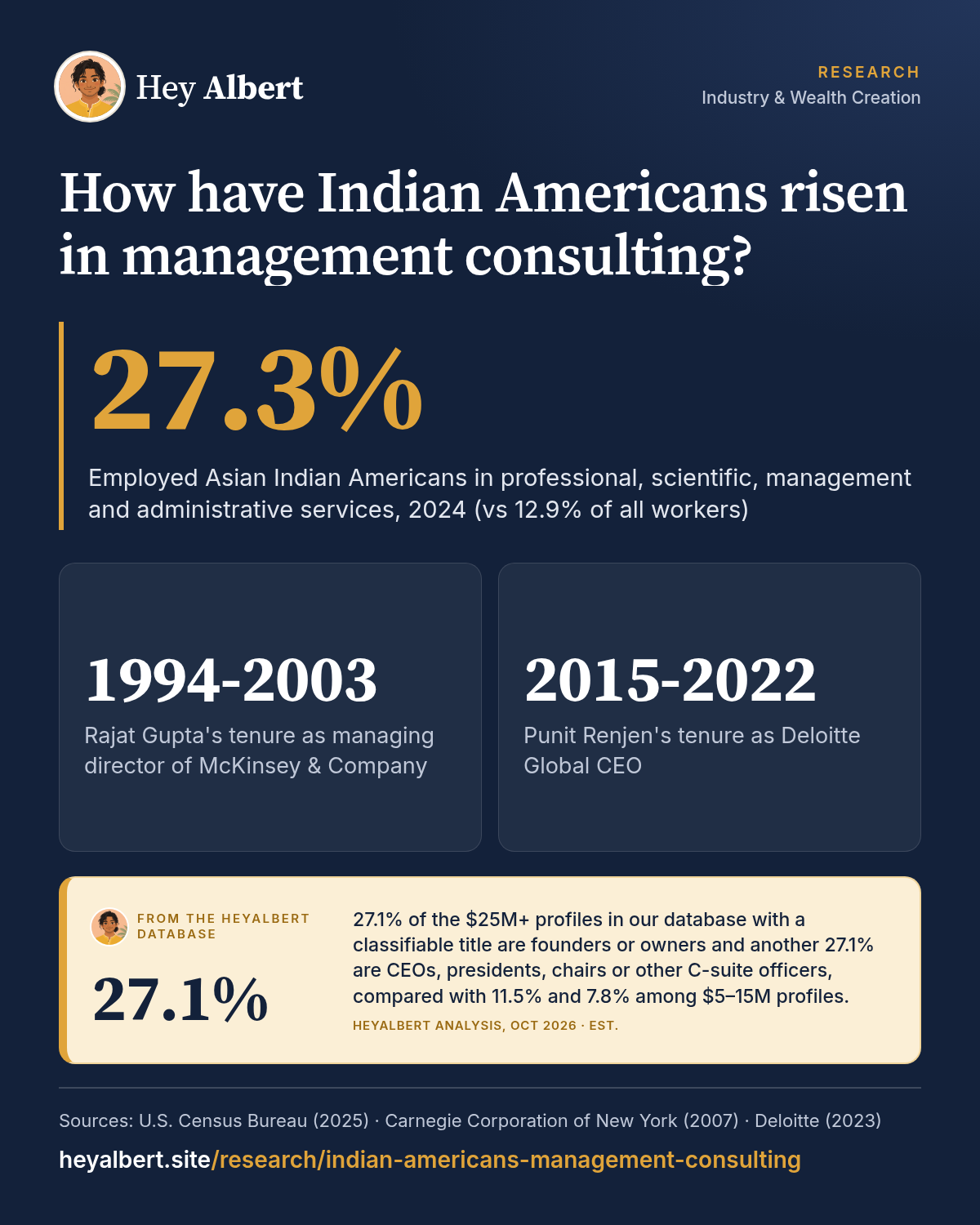
Indian Americans have reached the very top of management consulting: Rajat Gupta led McKinsey & Company from 1994 to 2003, and Punit Renjen was Deloitte's global CEO from 2015 to 20222,3,4. The broader pipeline is deep: in 2024, 27.3% of employed Asian Indian Americans worked in professional, scientific, management and administrative services, more than double the 12.9% share for all US workers1.
HeyAlbert data shows 27.1% of the $25M+ profiles in our database with a classifiable title are founders or owners and another 27.1% are CEOs, presidents, chairs or other C-suite officers, compared with 11.5% and 7.8% among $5–15M profiles. See the data · Methodology
A profession built on credentials
Management consulting recruits heavily from top MBA programs and technical degrees, and Indian Americans are unusually well credentialed. In 2024, 46.4% of Asian Indian adults aged 25 and older held a graduate or professional degree, against 14.7% of all US adults, according to the American Community Survey1. The same survey shows that 27.3% of employed Asian Indian Americans worked in the industry group covering professional, scientific, management and administrative services, which includes consulting firms, compared with 12.9% of all US workers1.
| ACS 2024 (1-year) | Asian Indian alone | All US |
|---|---|---|
| Employed in professional, scientific, management and administrative services | 27.3% | 12.9% |
| Graduate or professional degree (age 25+) | 46.4% | 14.7% |
| Bachelor's degree or higher (age 25+) | 78.8% | 36.8% |
Source: US Census Bureau, ACS 2024 1-year, S02011. No public data set counts consultants or consulting partners by ancestry, so these industry figures are the closest official measure. The academic route that feeds consulting is traced in the path from IIT and IIM to US executive leadership.
What HeyAlbert data shows
Leaders who reached the top
- Rajat Gupta, born in Calcutta in 1948, served as managing director of McKinsey & Company from 1994 to 2003. The Carnegie Corporation describes him as the first minority to lead the firm and the first Indian-born CEO of a multinational corporation; he also co-founded the Indian School of Business3. His later career ended in controversy: in 2012 a federal court sentenced him to two years in prison for insider trading, according to the US Attorney's Office for the Southern District of New York6.
- Punit Renjen came to the US at 18 on a Rotary Foundation scholarship and became Deloitte Global CEO in 2015, the first Asian-born person to lead one of the world's biggest professional services firms, according to the Carnegie Corporation2. Deloitte says he previously chaired Deloitte US (2011 to 2015) and was CEO of Deloitte Consulting (2009 to 2011), and retired as global CEO at the end of 20224. Carnegie notes Deloitte's revenue exceeded $50 billion in fiscal 2021 under his leadership2. Deloitte credits him with launching WorldClass, an initiative to prepare 100 million people for economic opportunity, and a commitment to reach net zero emissions by 20304.
These are examples from public biographies rather than a complete list; many Indian Americans hold partner and practice-leader roles across the major firms.
Consulting as a launch pad
For many professionals, consulting is a stepping stone rather than a destination. Firms typically hire from undergraduate and MBA programs, promote on a fixed timetable and expect many consultants to leave for client-side roles within a few years, so alumni networks spread widely across corporate America. The skills and networks built advising chief executives lead naturally into corporate leadership, private equity and entrepreneurship. Indian American executives who rose through general management are profiled in Indian American Fortune 500 CEOs, and the broader question of why so many Indian-born leaders run major US companies is explored in why so many tech CEOs are Indian. Moves into investing are covered in Indian Americans on Wall Street and in private equity.
Building firms of their own
Alongside careers at global firms, many Indian Americans run their own consulting and professional-services companies. The Census Bureau's Annual Business Survey counted 35,945 Asian Indian-owned employer firms in professional, scientific and technical services in 2022, with $80.2 billion in receipts and 345,026 employees5. That category also includes IT consulting, engineering, legal and accounting practices; the technology side is covered in Indian American IT services firms, and the full ownership picture in how many businesses Indian Americans own.
How consulting careers build wealth
For families, the profession's appeal lies partly in its predictability: a credential-driven career with high and relatively stable income supports saving, home ownership and education spending over decades. Consulting pays well from the start, and partners at leading firms share in firm profits, but the profession rarely produces the concentrated equity fortunes seen in technology founding. Its wealth effect tends to come later and indirectly: through corporate stock awards for those who move into industry, carried interest for those who move into private equity, and ownership for those who start firms. The equity mechanics are explained in equity compensation for Indian American executives, and the role of education in household wealth in Indian American education levels.
Frequently asked questions
Has an Indian American led McKinsey?
Yes. Rajat Gupta, born in India, was managing director of McKinsey & Company from 1994 to 2003. He was later convicted of insider trading and sentenced in 2012 to two years in prison.
Who was the first Asian-born CEO of a Big Four firm?
Punit Renjen, who became Deloitte Global CEO in 2015, is described by the Carnegie Corporation as the first Asian-born person to lead one of the world's biggest professional services firms.
How many Indian Americans work in consulting?
No data set counts consultants by ancestry. The closest measure is the American Community Survey, which shows 27.3% of employed Asian Indian Americans worked in professional, scientific, management and administrative services in 2024.
Why do many Indian Americans go into consulting?
High rates of graduate and technical education, strong MBA pipelines and the profession's role as a gateway to corporate leadership and investing all contribute.
Sources
Figures are from the public sources below, with the data year stated. Estimates are labeled as estimates. Accessed October 24, 2026.
- US Census Bureau, American Community Survey 2024 1-year, Selected Population Profile (S0201), Asian Indian alone (2025). data.census.gov ↩ ↩ ↩
- Carnegie Corporation of New York, Punit Renjen (Great Immigrants 2022) (2022). carnegie.org ↩ ↩ ↩
- Carnegie Corporation of New York, Rajat Gupta (Great Immigrants 2006, updated 2007) (2007). carnegie.org ↩ ↩ ↩
- Deloitte, Punit Renjen, Deloitte Global CEO Emeritus (profile) (2023). deloitte.com ↩ ↩ ↩
- US Census Bureau, Annual Business Survey: Statistics for Employer Firms by Industry, Sex, Ethnicity, Race, and Veteran Status for the U.S.: 2022 (AB2200CSA01) (2024). data.census.gov ↩ ↩
- US Attorney's Office, Southern District of New York, Former Chairman Of Consulting Firm And Board Director, Rajat Gupta, Sentenced ... To Two Years In Prison For Insider Trading (2012). justice.gov ↩