
Short answer
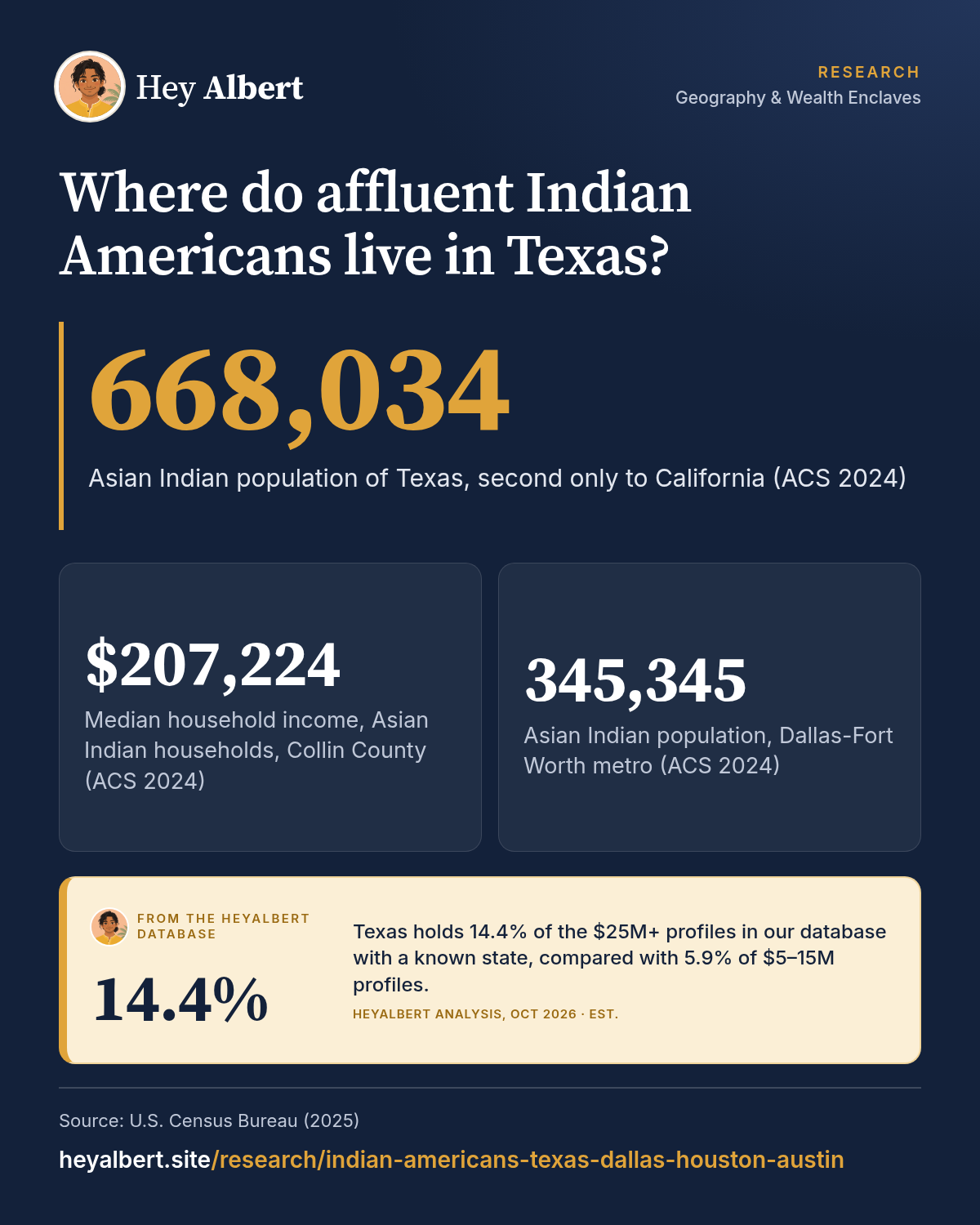
Most affluent Indian Americans in Texas live in the Dallas-Fort Worth, Houston and Austin metro areas. Collin County, north of Dallas, has the largest and highest-earning community: 149,186 Asian Indian residents with a median household income of $207,224 in 20241. Texas's Asian Indian population reached 668,034 in 2024, up about 38% from 2019, the largest increase of any state2,3.
HeyAlbert data shows Texas holds 14.4% of the $25M+ profiles in our database with a known state, compared with 5.9% of $5–15M profiles. See the data · Methodology
Texas is the fastest-growing major Indian American state
Texas had 668,034 residents who identified as Asian Indian alone in 2024, second only to California's 970,7172. The state added about 185,000 Asian Indian residents between 2019 and 2024, more than any other state, our calculation from ACS 1-year estimates2,3. The median Asian Indian household in Texas earned $167,991, about twice the statewide median of $79,7212,6.
The growth is concentrated in three metros: Dallas-Fort Worth (345,345 Asian Indian residents), Houston (172,224) and Austin (101,820)4. For context on other states, see states with the largest Indian American populations.
What HeyAlbert data shows
Dallas-Fort Worth: Collin and Denton counties
Dallas-Fort Worth is now the second-largest Asian Indian metro in the US after New York, and its Asian Indian median household income was $178,315 in 20244. The wealthiest part of the region is its northern suburbs:
- Collin County (Plano, Frisco, McKinney, Allen): 149,186 Asian Indian residents, 11.9% of the county, median household income $207,224, against $124,316 for all county households1
- Denton County: 68,004 residents, 6.5% of the county, median household income $196,335, homeownership 84.1%1
- Dallas County (including Irving and Coppell): 85,182 residents, median household income $147,2301
Collin County's Asian Indian population nearly doubled in five years, from 81,206 in 2019 to 149,186 in 20241,7. In the Census Bureau's 2020-2024 five-year estimates, the cities with the most Asian Indian residents in Texas are Frisco (about 42,400, 19.3% of the city), Irving (about 41,300, 16.1%) and Plano (about 35,900, 12.4%); in Coppell the share is 18.7%5.
Houston: Fort Bend County and Sugar Land
The Houston metro had 172,224 Asian Indian residents in 2024, with a median household income of $165,8504. Fort Bend County, southwest of the city, stands out: 79,466 Asian Indian residents, a median household income of $198,701, and a homeownership rate of 87.4%, among the highest of any large Asian Indian community in the country1. Sugar Land, in Fort Bend, had about 14,100 Asian Indian residents, 12.9% of the city, in the 2020-2024 estimates5.
Houston's Asian Indian workforce leans toward health care: 25.6% of employed Asian Indians in the metro work in education and health care services, compared with 16.3% in Dallas-Fort Worth4. See our research on Indian American physicians.
Austin: the youngest tech hub
Austin crossed the Census Bureau's publication threshold for Asian Indian metro data in 2024, with 101,820 residents4. Its community is among the most educated in the country: 91.1% of Asian Indian adults 25 and older hold at least a bachelor's degree and 56.9% hold a graduate or professional degree4. Professional, scientific and management services employ 38.4% of Asian Indian workers in the metro4, reflecting Austin's technology sector. Our post on the Bay Area covers the older tech hub Austin is often compared with.
Not one community but several
The county figures show real variation. In Collin County, 88.3% of Asian Indian adults 25 and older hold a bachelor's degree or higher and 51.9% a graduate or professional degree1. Dallas County's Asian Indian community has a lower median income ($147,230) and a homeownership rate of 46.9%, meaning more than half of those households rent1. Harris County, which includes most of the city of Houston, has a median Asian Indian household income of $155,0981. Averages for the state, or even for a metro, hide these differences, which matter for anyone trying to understand the market. Our analysis of the Indian American income distribution looks at the spread nationally.
Why Texas: jobs, housing and taxes
Three factors come up repeatedly. First, jobs: Dallas-Fort Worth's Asian Indian workforce is concentrated in professional services (32.6%) and finance, insurance and real estate (17.1%)4. Many work in technology and IT services, a sector we examine in Indian American IT services firms.
Second, housing. The median home value for Asian Indian homeowners was $648,500 in Dallas-Fort Worth and $516,100 in Houston, against $1,785,700 in the San Jose metro4. A family can buy far more house in Texas on a similar income.
Third, taxes. Texas does not have a personal income tax, as the Texas Comptroller notes8. Whether that drives moves is a separate question, which we weigh in whether Indian Americans are moving to Texas and Florida for tax reasons.
Why this matters for advisors and businesses
The Texas market has changed quickly. Collin and Fort Bend counties combine six-figure median incomes, high homeownership and fast growth, making them key markets for wealth managers, real estate professionals and philanthropic organizations. Families who own homes and businesses also bring estate and succession questions; see Indian American family businesses.
Frequently asked questions
Where do most Indian Americans live in Texas?
In the Dallas-Fort Worth area, which had about 345,000 Asian Indian residents in 2024, followed by Houston with about 172,000 and Austin with about 102,000.
Which Texas city has the most Indian Americans?
Frisco, with about 42,400 Asian Indian residents (19.3% of the city), according to Census 2020-2024 five-year estimates. Irving and Plano are close behind.
Which Texas county has the wealthiest Indian Americans?
Collin County, north of Dallas, where the median Asian Indian household income was $207,224 in 2024. Fort Bend County near Houston was close at $198,701.
How fast is the Indian American population in Texas growing?
Texas's Asian Indian population grew about 38% between 2019 and 2024, from about 483,000 to about 668,000, based on ACS 1-year estimates.
Sources
Figures are from the public sources below, with the data year stated. Estimates are labeled as estimates. Accessed October 24, 2026.
- US Census Bureau, S0201 Selected Population Profile, Asian Indian alone and total population, by county (ACS 2024 1-year) (2025). data.census.gov ↩ ↩ ↩
- US Census Bureau, S0201 Selected Population Profile, Asian Indian alone, by state (ACS 2024 1-year) (2025). data.census.gov ↩ ↩ ↩
- US Census Bureau, S0201 Selected Population Profile, Asian Indian alone, by state (ACS 2019 1-year) (2020). data.census.gov ↩ ↩
- US Census Bureau, S0201 Selected Population Profile, Asian Indian alone, by metro area (ACS 2024 1-year) (2025). data.census.gov ↩ ↩ ↩
- US Census Bureau, B02015 Asian Alone by Selected Groups and B01003 Total Population, Texas places (ACS 2020-2024 5-year) (2025). data.census.gov ↩ ↩ ↩
- US Census Bureau, S0201 Selected Population Profile, total population, by state (ACS 2024 1-year) (2025). data.census.gov ↩
- US Census Bureau, S0201 Selected Population Profile, Asian Indian alone, by county (ACS 2019 1-year) (2020). data.census.gov ↩
- Texas Comptroller of Public Accounts, Starting a New Business (Fiscal Notes) (2016). comptroller.texas.gov ↩